
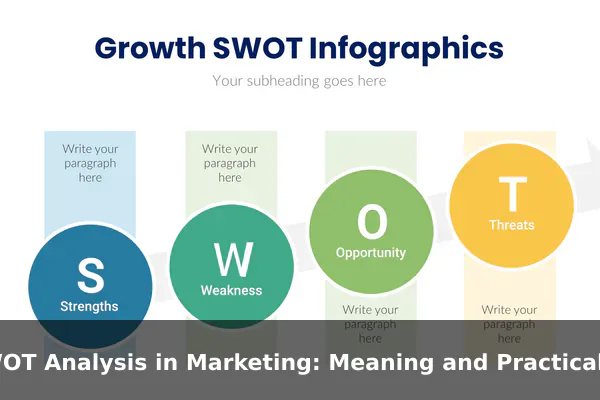
Every marketing decision — whether you’re launching a product, choosing a new channel, or entering a different market — carries risk. One of the most effective ways to reduce that risk is to pause before acting and take an honest look at where your brand stands. SWOT analysis gives marketers a structured framework to do exactly that.
Originally developed as a business planning tool, SWOT has become a standard exercise in marketing teams of every size. When applied correctly, it turns broad observations about your brand and market into clear, actionable insights that guide real campaign and strategy decisions. This guide explains what SWOT means in a marketing context, how each element works, and how you can apply it with practical examples.
What SWOT Analysis Means in Marketing
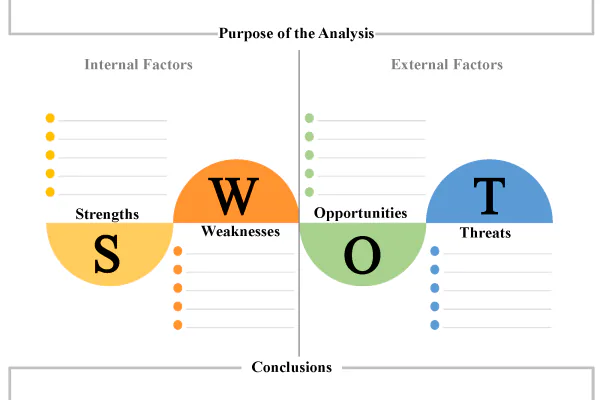
SWOT stands for Strengths, Weaknesses, Opportunities, and Threats. It is a two-by-two matrix that separates internal factors — what your brand controls — from external factors — what exists in the market around you.
In a marketing context, the framework helps you assess your current position before committing to a strategy. Rather than jumping straight into campaign execution, SWOT encourages you to ask four foundational questions:
- Strengths – What marketing advantages does your brand already have?
- Weaknesses – Where does your marketing fall short compared to competitors?
- Opportunities – What market trends or gaps could you take advantage of?
- Threats – What external pressures could hurt your marketing efforts?
The answers to these questions shape every downstream decision, from messaging and positioning to channel selection and budget allocation.
Why SWOT Matters for Marketing Strategy
Marketing without context is guesswork. SWOT gives your strategy a factual foundation by connecting internal capability to external reality. Specifically, it helps with:
- Brand positioning – Knowing your strengths helps you communicate differentiation clearly and confidently.
- Audience targeting – Recognizing weaknesses helps you avoid markets you are not equipped to serve effectively.
- Channel selection – Opportunities often reveal emerging platforms or content formats worth investing in early.
- Competitive awareness – Threats keep you realistic about what competitors can take from you if you are not prepared.
- Budget allocation – Prioritizing SWOT findings helps you direct spend where it will have the highest impact.
Without this structure, marketing plans tend to reflect optimism rather than reality, leading to wasted budget and missed targets.
The Four Parts of a Marketing SWOT Analysis
Strengths
Strengths are internal assets that give your brand a marketing advantage. Examples include a strong brand reputation, a loyal customer base, high-quality content production capability, an established social media following, or exclusive access to a proprietary product feature. These are factors you control and can leverage directly in campaigns and messaging.
Weaknesses
Weaknesses are internal limitations that reduce your marketing effectiveness. Common examples include a small advertising budget, a website with poor mobile experience, low brand awareness in a target segment, or a product that lacks a clear differentiator from established competitors. Identifying these honestly prevents you from building campaigns on shaky foundations.
Opportunities
Opportunities are external conditions your brand could benefit from. These might include growing consumer interest in a product category, a competitor exiting the market, a new social platform gaining traction with your target audience, or a cultural trend that aligns naturally with your brand values. Opportunities are not guaranteed — they require the right internal strengths to exploit them successfully.
Threats
Threats are external factors that could undermine your marketing results. Rising advertising costs, new market entrants, algorithm changes on key platforms, shifting consumer preferences, or broader economic downturns all qualify. Unlike weaknesses, threats exist outside your direct control — but you can prepare for them strategically once you have named them clearly.
How to Build a SWOT Analysis Step by Step
Building a marketing SWOT does not require sophisticated software — it requires honest input and the right questions. Follow these steps:
- Gather data first. Pull together marketing analytics, customer feedback, competitive research, and industry reports before filling in the matrix.
- List internal factors. Identify what your brand does well and where it struggles. Be specific — “strong email open rates averaging 38%” is far more useful than “good marketing.”
- List external factors. Scan your market for trends, competitor activity, and emerging audience behaviors. Use social listening tools, keyword research, and competitor audits.
- Prioritize insights. Not every factor carries equal weight. Highlight the two or three items in each quadrant that have the highest impact on your current marketing goals.
- Turn findings into strategy. Use SO (Strength-Opportunity), WO (Weakness-Opportunity), ST (Strength-Threat), and WT (Weakness-Threat) combinations to generate specific, testable marketing actions.
The final output should be a concise list of priorities, not an exhaustive inventory of every factor you could imagine.
Practical SWOT Analysis Examples in Marketing

Small Business — Local Coffee Shop
A local coffee shop might identify its strength as a loyal neighborhood community and exceptional barista craft. Its weakness is a limited marketing budget and no online ordering system. An opportunity exists in the growing popularity of specialty coffee content on short-form video platforms. A threat is a large chain opening two blocks away. The strategic action: invest time rather than money into short-form video content that showcases the craft experience and community atmosphere before the chain opens — using an existing strength to capture an opportunity while countering a threat.
Product Launch — New Skincare Line
A mid-size brand launching a new skincare product has a strength in existing customer trust and an email list of 50,000 subscribers. Its weakness is no prior presence in the premium skincare segment. An opportunity is rising consumer interest in clean beauty ingredients. A threat is established competitors with larger influencer budgets. Action: use the existing email list for an exclusive early-access launch while partnering with micro-influencers in the clean beauty niche to build credibility cost-effectively rather than competing head-to-head on paid media spend.
Digital Campaign — SaaS Company
A software company running paid search has a strength in a high-converting landing page with a 12% trial signup rate. Its weakness is a rising cost-per-click in competitive branded keywords. An opportunity is a clear gap in competitor content for mid-funnel educational search queries. A threat is increasing CPC from new market entrants. Action: redirect part of the paid budget toward SEO content targeting educational queries at a lower cost, reducing dependency on expensive keywords while building longer-term organic traffic.
Common Mistakes Marketers Should Avoid
Even experienced marketers make errors when running a SWOT analysis. The most damaging ones include:
- Being too vague. Phrases like “good product” or “strong team” tell you nothing actionable. Use specific, observable observations tied to real data.
- Overloading the matrix. A quadrant with 20 items is impossible to act on. Keep each section to three to five high-priority findings.
- Treating it as a one-time exercise. Markets shift. A SWOT completed 18 months ago may be dangerously outdated today.
- Stopping at the matrix. The analysis is only valuable if it leads to concrete strategy decisions. A finished SWOT with no action plan is a missed opportunity.
- Relying only on internal perspectives. Teams often have blind spots. Include real customer feedback and third-party competitive data to challenge internal assumptions before finalizing the matrix.
Turning SWOT Findings Into a Marketing Action Plan
The SWOT matrix is a diagnostic tool, not a finished strategy. To convert findings into action, use these four strategic combinations:
- SO strategies (Strength + Opportunity): Use your advantages to capture emerging market openings. Example: if your strength is video production and the opportunity is the rise of short-form content, launch a structured campaign on the platform gaining your audience.
- WO strategies (Weakness + Opportunity): Address a weakness specifically so you can take advantage of a market trend before the window closes.
- ST strategies (Strength + Threat): Use a proven strength to defend against competitive pressure. Example: if brand loyalty is your strength and a competitor is cutting prices, reinforce loyalty with exclusive member benefits rather than matching the price cut.
- WT strategies (Weakness + Threat): Minimize exposure by avoiding areas where you are both weak and under external threat — preserving budget for higher-probability bets.
Each strategic combination should map to a specific campaign idea, measurable KPI, or budget line item so accountability is built in from the start.
When to Use SWOT Analysis in Marketing Work
SWOT is not a daily tool, but there are clear moments when running one delivers significant value for your marketing decisions:
- Before planning your annual or quarterly marketing strategy
- When launching a new product, service, or brand into the market
- During a rebrand or major messaging change
- When entering a new geographic or demographic market segment
- After a significant shift in competitor activity or market conditions
- When a campaign underperforms and you need a structured way to diagnose why
Treat SWOT as a checkpoint, not a formality. When it is done with honest data and converted into clear priorities, it consistently improves the quality of marketing decisions and reduces the risk of investing in the wrong direction.
SWOT analysis gives marketers something genuinely valuable: a moment of structured honesty before committing resources. By mapping internal strengths and weaknesses against external opportunities and threats, you gain the clarity needed to build strategies that are grounded in reality rather than assumption. Whether you are a solo marketer at a startup or part of a larger team, running a focused SWOT before your next campaign will sharpen your thinking and improve your outcomes. The framework itself is simple — but the discipline to use it consistently and act on its findings decisively is what separates reactive marketing from intentional, results-driven strategy.
