
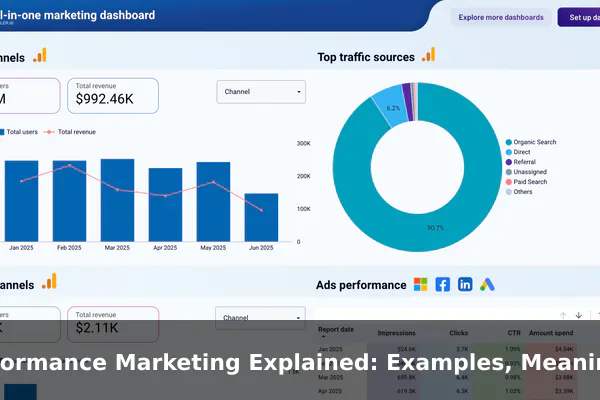
Performance marketing is one of the clearest ways to understand modern marketing because it ties spending to visible outcomes. Instead of paying mainly for exposure and hoping it turns into revenue later, businesses use performance marketing to focus on measurable actions such as clicks, leads, app installs, form submissions, and direct sales. That makes it especially useful for companies that want to know what is working, what is not, and where to put the next dollar.
For beginners, the idea is simple: you pay to drive a specific result, then track that result closely enough to improve it over time. This approach has become central to online growth because digital channels make it possible to monitor user behavior in detail. A marketer can launch a campaign, see which ad brings better traffic, compare landing pages, and shift budget toward what produces the best return.
This article explains the meaning of performance marketing in plain English, shows how it works in practice, and breaks down the main examples, benefits, metrics, and mistakes. If you want a practical understanding of why so many brands rely on this model for measurable growth, this guide will give you the foundation.
What Performance Marketing Means
Performance marketing is a results-driven marketing approach in which advertisers and marketing partners focus on specific, trackable outcomes. Those outcomes might include a website visit, a lead, a booked consultation, a free trial, a completed purchase, or another meaningful business action.
The word performance matters because success is judged by what the campaign produces, not simply by how many people might have seen it. In traditional advertising, a company might pay for a billboard, a magazine page, or a TV spot and then estimate the value later. In performance marketing, the goal is much more concrete: generate action and measure the cost of that action.
The core idea behind the model
At its core, performance marketing tries to answer a practical business question: What did this budget actually achieve? That question changes how campaigns are planned and managed. Marketers do not just create messages and launch them. They also build tracking systems, define target metrics, test creative variations, and optimize the journey from ad click to final conversion.
Why it is different from broad awareness campaigns
Not every marketing activity is designed to produce immediate conversions. Some campaigns exist to make a brand more memorable, trusted, or recognizable over time. Performance marketing is different because it usually emphasizes shorter feedback loops. Results appear faster, and decisions can be adjusted quickly based on data.
That does not mean performance marketing is better than every other form of promotion. It means it serves a different purpose. It is built for measurement, efficiency, and direct response.
What businesses usually pay for
Depending on the platform and campaign objective, advertisers may pay for different event types:
- Clicks when traffic is the immediate goal
- Leads when a business wants inquiries or contact submissions
- Sales when revenue is the main objective
- App installs when growth depends on user acquisition
- Qualified actions such as registrations, demo requests, or subscriptions
This measurable structure is why performance marketing is so attractive to businesses that care about return on investment, budget accountability, and controlled growth.
How Performance Marketing Works
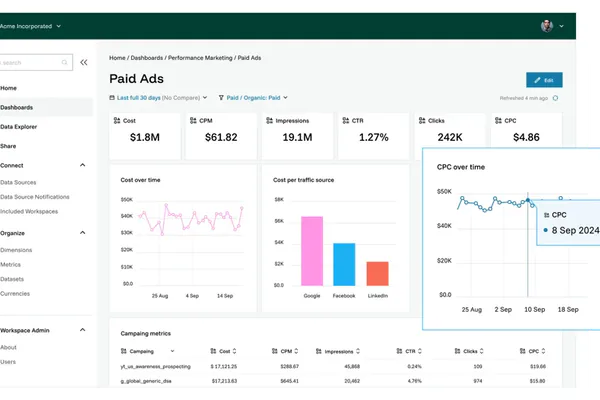
Performance marketing works through a repeatable cycle of goal setting, campaign execution, tracking, and optimization. It is not just about running ads. It is about building a system that turns attention into measurable business results.
1. Set a clear goal
Every performance campaign starts with a defined objective. Without that, the data becomes noisy and hard to interpret. A local service business might want booked appointments. An online store might want purchases. A software company might want free trial signups.
The clearer the goal, the easier it is to choose the right platform, message, landing page, and metric.
2. Choose the right channel
Different channels support different buyer behaviors. Someone searching on Google may already be looking for a solution. Someone scrolling through social media may need stronger creative and a clearer reason to stop and click. The channel should match how the audience discovers, compares, and buys.
3. Build a trackable campaign
Tracking is the operational backbone of performance marketing. This usually includes analytics tools, pixels, conversion events, UTM parameters, call tracking, CRM integrations, or e-commerce tracking. If tracking is weak, the campaign may appear profitable when it is not, or appear unprofitable when it is actually working.
4. Send traffic to a conversion-focused destination
The ad is only the first step. The landing page, product page, signup form, or checkout experience must be built to continue the momentum. A campaign often fails not because the ad is bad, but because the page after the click is confusing, slow, or poorly matched to the offer.
5. Measure, test, and optimize
Once data starts coming in, marketers compare results and make adjustments. They may test new headlines, refine audiences, pause underperforming keywords, improve the offer, or adjust bidding strategy. This is where performance marketing becomes powerful: it improves through iteration.
A simple version of the process looks like this:
- Define the business result you want
- Create a campaign aimed at that result
- Track what users do
- Calculate cost versus outcome
- Improve the best-performing elements
- Scale what proves profitable
This cycle is why performance marketing is often described as both a marketing method and a growth system.
Main Channels Used in Performance Marketing
Performance marketing can happen across several digital channels, but the channels themselves are not the main point. The key factor is whether they can be managed around measurable results.
Paid search
Paid search campaigns appear when users actively search for products, services, or answers. This channel is often effective because it captures demand that already exists. A business selling accounting software, for example, may target searches related to invoicing tools or bookkeeping platforms and measure which keywords produce signups or sales.
Paid social advertising
Social platforms help brands reach specific audiences based on interests, behaviors, demographics, and past engagement. These campaigns are often useful for lead generation, product discovery, retargeting, and low-friction offers such as downloads or trial registrations.
Affiliate partnerships
Affiliate marketing becomes part of performance marketing when publishers, creators, or comparison sites earn commissions based on tracked sales or leads. The business pays for outcomes rather than guaranteed exposure. This channel can expand reach without taking on all promotional risk upfront.
Display and retargeting ads
Display ads place visual messages across websites and apps. On their own, they may support awareness, but they become strongly performance-oriented when used for retargeting. For example, a store can show product ads to users who viewed an item but did not purchase, then measure the conversion lift from that follow-up exposure.
Native advertising
Native ads are designed to match the surrounding content environment more naturally. They often work well for driving traffic to educational pages, comparison content, or lead magnets where the first conversion step is a click or signup rather than an immediate sale.
Influencer campaigns with performance goals
Some creator campaigns are brand-led, while others are structured around tracked outcomes such as affiliate sales, referral codes, or cost per acquisition targets. In that case, the influencer is not just promoting visibility. They are contributing to measurable performance goals.
The important takeaway is this: performance marketing is not one channel. It is a measurable way of using channels.
Examples of Performance Marketing in Action
One of the easiest ways to understand performance marketing is to see how it works in realistic business situations. The model looks slightly different depending on what the company sells and how people buy.
E-commerce sales campaign
An online skincare brand launches paid social ads for a new product bundle. The campaign sends users to a dedicated landing page with customer reviews, clear benefits, and a limited-time offer. The team tracks purchases, average order value, and return on ad spend. Ads that generate cheap clicks but few purchases are paused. Ads that produce profitable sales receive more budget.
In this example, the business is not satisfied with traffic alone. It cares about sales efficiency.
Lead generation for a service business
A home renovation company runs search ads targeting phrases such as kitchen remodeling estimates and bathroom contractor near me. Instead of optimizing for clicks only, the company tracks quote requests, phone calls, and booked consultations. Over time, it learns that some keywords bring many inquiries but poor-quality leads, while others bring fewer leads that convert into higher-value jobs.
This is performance marketing because the company is measuring business value beyond surface traffic numbers.
Software free trial acquisition
A SaaS company promotes a 14-day trial through search, social, and retargeting campaigns. The first conversion is a trial signup, but the team also measures what happens later: activation rate, paid upgrade rate, and customer acquisition cost. That helps prevent a common mistake, which is buying large numbers of low-quality signups that never become paying customers.
Mobile app install campaign
A fitness app runs install campaigns through ad networks and social platforms. At first glance, cost per install looks like the main metric. But the smarter team also tracks retention, subscription upgrades, and revenue per user. If one ad source generates cheap installs that disappear after two days, it may actually be worse than a source with a higher upfront cost but better long-term value.
Affiliate-driven product launch
A niche online retailer works with content publishers and review creators who share tracked links. Partners earn commissions only when referred visitors complete a purchase. The retailer benefits from expanded promotion without paying for guaranteed impressions, and the partners are motivated to create content that converts rather than content that simply gets attention.
Across all of these examples, the shared pattern is clear:
- The campaign has a defined action goal
- The business tracks that action closely
- Performance is judged by efficiency and outcome quality
- Budget moves toward what delivers the strongest return
Key Benefits for Businesses
Performance marketing is popular because it gives businesses more control, more visibility, and more opportunities to improve results without relying on guesswork.
Measurable return on investment
The biggest advantage is visibility into what spend produces. When campaigns are tracked properly, a business can compare budget to leads, sales, and revenue instead of relying on broad assumptions.
Better budget control
Performance marketing makes it easier to allocate money intentionally. If one campaign produces high-quality customers and another underperforms, spend can be adjusted quickly. That flexibility is valuable for both small businesses and larger growth teams.
Faster learning cycles
Because data appears quickly, businesses can learn at a faster pace. They can test offers, messages, audience segments, and landing pages without waiting months to understand what happened.
More precise targeting
Digital platforms allow campaigns to reach users based on search intent, interests, demographics, prior site visits, or behavioral signals. This reduces wasted exposure and increases the chance that budget reaches the right audience.
Scalable customer acquisition
Once a campaign proves profitable, it can often be expanded carefully. Scaling may involve increasing budget, adding new creatives, expanding keyword groups, opening new geographic areas, or building lookalike audiences based on existing customers.
Clearer accountability across teams
Performance marketing also improves internal decision-making. When goals and metrics are visible, sales teams, marketers, analysts, and business owners can align around the same numbers rather than debating assumptions.
For many businesses, the benefits can be summarized this way:
- Less guesswork about what marketing is doing
- More confidence in budget decisions
- Stronger optimization based on real user behavior
- Better growth discipline when scaling campaigns
That said, the benefits only appear when tracking, messaging, and offer quality are strong. Performance marketing is not magic. It is a disciplined system.
Important Metrics to Track
Metrics are what turn performance marketing from a promotional activity into a measurable operating model. Beginners often look at too many numbers at once, but a smaller set of meaningful metrics usually tells the story more clearly.
Cost per click (CPC)
CPC shows how much you pay, on average, for each click. It helps evaluate traffic costs, especially in search and social campaigns. A lower CPC can be useful, but only if the traffic converts well.
Click-through rate (CTR)
CTR measures how often people click after seeing the ad. It can indicate whether the creative, message, or targeting is relevant. A strong CTR suggests the ad is attracting interest, though interest alone is not enough.
Conversion rate
Conversion rate tells you what percentage of visitors complete the desired action. This is one of the most important metrics because it reflects the strength of the full journey, including the offer, landing page, trust signals, and user experience.
Cost per acquisition (CPA)
CPA shows how much it costs to generate a lead, customer, or other target action. Many businesses use CPA as a core decision metric because it connects spend directly to outcomes.
Return on ad spend (ROAS)
ROAS compares revenue to ad spend. If a store spends $1,000 and generates $4,000 in attributable revenue, the ROAS is 4:1. This metric is especially useful in e-commerce and direct-response campaigns.
Customer acquisition cost (CAC)
CAC goes beyond campaign-level spend and looks at the broader cost of winning a customer. It is especially helpful when comparing acquisition efficiency across channels or time periods.
Lead quality and downstream conversion
Not every lead is equally valuable. A campaign that produces many cheap leads may still be weak if very few turn into paying customers. That is why advanced performance marketers look beyond front-end metrics and examine what happens further down the funnel.
A simple way to think about metrics is to separate them into three groups:
- Attention metrics: impressions, CTR, CPC
- Action metrics: conversion rate, CPA, cost per lead
- Business outcome metrics: ROAS, CAC, revenue, profit contribution
The most common mistake is optimizing only the first group. Strong performance marketing connects all three.
Performance Marketing vs Brand Marketing
This comparison matters because businesses often treat performance marketing and brand marketing as if one must replace the other. In reality, they solve different problems.
Performance marketing focuses on immediate, trackable action
Its strength is direct measurement. It works well when a business wants to drive signups, leads, purchases, or another concrete response that can be linked to spend.
Brand marketing focuses on long-term perception
Brand marketing helps people recognize, remember, and trust a business over time. It influences preference, pricing power, and customer loyalty, even when the effect is not immediately visible in a one-campaign dashboard.
Why the best companies often use both
Performance campaigns usually work better when the audience already knows and trusts the brand. At the same time, brand investment becomes more commercially useful when a company also has efficient systems for converting demand into measurable sales or leads.
In simple terms:
- Brand marketing builds future demand
- Performance marketing captures and converts demand
A new business with a limited budget may lean heavily toward performance marketing at first because it needs fast learning and visible return. As it matures, it may invest more in brand building so future performance campaigns become easier and more efficient.
This relationship is important because many weak marketing strategies fail by chasing only short-term clicks while neglecting trust, differentiation, and memory.
Common Mistakes and Best Practices
Performance marketing looks data-driven on the surface, but many campaigns still fail because the system behind the data is weak. Most problems come from poor setup, poor interpretation, or poor alignment between the ad and the real business objective.
Common mistakes
- Tracking the wrong event: optimizing for clicks when the real goal is qualified leads or profitable sales
- Using vague offers: asking users to act without giving them a clear reason
- Sending traffic to weak landing pages: slow pages, confusing layouts, and weak calls to action reduce conversion
- Chasing cheap traffic: low-cost clicks can still be expensive if they never convert
- Ignoring funnel quality: a campaign may appear strong until sales follow-up or retention data reveals weak lead quality
- Scaling too fast: increasing budget before the campaign is stable often lowers efficiency
Best practices
- Define success before launch. Choose the business metric that actually matters.
- Match the message to user intent. The ad, landing page, and offer should feel connected.
- Test one meaningful variable at a time. This makes results easier to interpret.
- Watch both front-end and back-end data. Clicks and leads matter, but so do purchases, retention, and revenue quality.
- Improve the conversion path. Better forms, faster pages, clearer copy, and stronger trust signals often produce major gains.
- Scale gradually. Increase spend in controlled steps while monitoring performance changes.
The strongest performance marketers do not only ask, How can we get more traffic? They ask, How can we improve the economics of the whole system?
Who Should Use Performance Marketing
Performance marketing is useful for many kinds of businesses, but it is especially valuable when results can be tracked clearly and the business needs disciplined customer acquisition.
E-commerce brands
Online stores often benefit because purchases, revenue, and product-level performance can be tracked directly. This makes optimization and scaling more practical.
Service businesses
Law firms, agencies, home service companies, clinics, and consultants can use performance marketing to generate form submissions, phone calls, and booked appointments, then connect campaigns to closed deals.
Software and subscription businesses
SaaS companies often rely on performance campaigns to acquire trials, demos, or subscriptions. The best setups track not just signups, but activation, retention, and lifetime value.
Startups and growth-stage companies
When resources are limited, measurement matters. Startups often choose performance marketing because it creates faster feedback and helps prove which acquisition paths deserve more investment.
Local businesses with defined service areas
Businesses that serve specific cities or neighborhoods can use geo-targeted campaigns to generate inquiries efficiently, especially when search intent is strong.
Performance marketing may be a weaker fit when a business has no reliable tracking, no clear offer, or a very long buying cycle that is hard to measure. In those cases, the company may need better infrastructure before the channel can work well.
How to Start With Performance Marketing Without Wasting Budget
Many beginners assume success comes from launching on as many platforms as possible. In reality, the better approach is usually narrower and more disciplined.
Start with one goal and one main channel
Choose the most important action for the business right now, then select the channel most closely aligned with that intent. A company that needs immediate demand capture may start with paid search. A visually driven product may start with paid social and retargeting.
Build the measurement setup first
Before launching, confirm that key events are tracked correctly. If leads go into a CRM, connect that data. If purchases happen online, verify revenue attribution. A campaign without reliable measurement is expensive guesswork.
Create a focused offer
People respond better when the value proposition is specific. That might be a free consultation, a limited-time product bundle, a trial, a downloadable guide, or a clear service estimate. Weak offers produce weak performance even when targeting is solid.
Improve the landing experience
The page after the click should answer obvious user questions quickly. What is this? Why should I care? Why should I trust you? What should I do next? Better clarity often improves results more than endlessly changing ad settings.
Review results with patience and discipline
Do not panic over every small fluctuation. Gather enough data to make informed decisions, but do not let underperforming campaigns run too long without a clear hypothesis for improvement. The goal is controlled learning, not random experimentation.
A practical beginner framework looks like this:
- Choose one conversion goal
- Launch one channel with clear targeting
- Use one strong offer
- Track the full path to outcome
- Optimize based on conversion quality, not vanity metrics
Conclusion
Performance marketing is best understood as a measurable growth approach, not just a collection of ad platforms. Its real value comes from linking spending to defined outcomes, learning quickly from data, and improving the economics of customer acquisition over time.
For businesses that want clarity, accountability, and scalable results, performance marketing offers a practical framework. It can drive leads, sales, signups, and other meaningful actions, but only when goals are clear, tracking is reliable, and optimization focuses on real business value rather than surface metrics.
The most effective use of performance marketing is not simply getting more clicks. It is building a repeatable system that turns budget into measurable progress. When businesses understand that distinction, they stop treating marketing as guesswork and start treating it as an engine for disciplined growth.
