
Customer Acquisition Cost, usually shortened to CAC, is one of the most important numbers in marketing and business growth. It tells you how much money a company spends to acquire one new customer. That sounds simple, but CAC becomes much more useful when you treat it as a decision-making metric rather than just a number on a report.
Businesses use CAC to judge whether their marketing is efficient, whether their sales process is too expensive, and whether growth is actually profitable. A company can increase revenue and still struggle financially if the cost of getting each new customer is too high. That is why founders, marketers, and finance teams often watch CAC closely.
In this guide, you will learn the meaning of Customer Acquisition Cost, the standard CAC formula, the right way to calculate it, and practical examples you can apply to a campaign, a sales channel, or an entire business period. You will also see common mistakes that distort CAC and practical ways to reduce it without slowing healthy growth.
What Customer Acquisition Cost (CAC) Actually Measures
Customer Acquisition Cost measures the total cost of winning a new customer over a defined period. In plain terms, it answers this question: how much did we spend to turn non-customers into paying customers?
This metric matters because customer growth is never free. A business might spend money on advertising, content, design, software tools, sales calls, commissions, agency retainers, and employee salaries. CAC helps bring those scattered costs together into one number that is easier to evaluate.
What CAC includes in practice
The exact definition can vary slightly by company, but CAC usually includes costs directly tied to attracting, converting, and closing new customers.
- Advertising spend across search, social, display, and other paid channels
- Marketing software and automation tools
- Agency or freelancer fees
- Salaries and commissions for marketing and sales teams
- Creative production costs such as landing pages, copywriting, and design
- Promotional offers used to win first-time buyers
What CAC does not automatically include
Some businesses exclude broader overhead from CAC, especially when they want a narrow channel-level view. For example, office rent or company-wide administrative costs are often kept outside a basic CAC calculation. The key is consistency. If you include a cost in one period, you should apply the same logic in the next period when comparing performance.
Why CAC is more than a reporting metric
CAC is not just a number for dashboards. It helps answer practical questions such as:
- Is a campaign producing profitable growth?
- Which acquisition channel deserves more budget?
- Are sales and marketing teams operating efficiently?
- Can the business scale without burning too much cash?
That strategic use is what makes CAC different from a simple spend total. It connects spending to actual customer creation.
The CAC Formula Explained
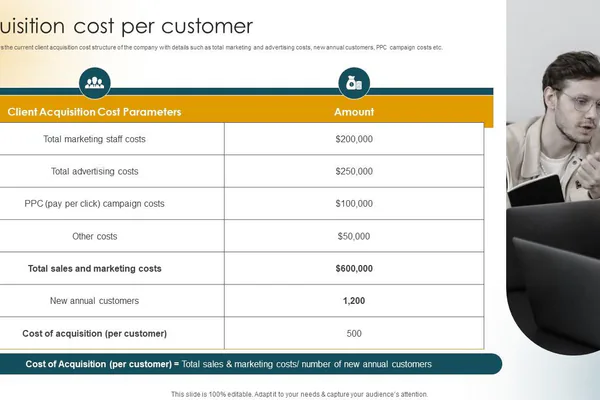
The standard formula for Customer Acquisition Cost is straightforward:
CAC = Total acquisition costs / Number of new customers acquired
This formula looks simple, but the quality of the result depends on what you include in the numerator and how accurately you count the denominator.
The numerator: total acquisition costs
This is the total amount spent to acquire customers during a specific period. Depending on your reporting style, this may include:
- Paid media spend
- Marketing team salaries
- Sales salaries and commissions
- CRM and email platform fees
- Agency retainers
- Production costs for campaigns and assets
Some companies calculate two versions of CAC:
- Blended CAC, which includes all meaningful sales and marketing costs
- Paid CAC, which focuses mostly on media spend or a specific paid channel
Both can be useful. Blended CAC shows the real all-in cost of growth, while paid CAC can help with campaign optimization.
The denominator: new customers acquired
This is the number of new paying customers gained in the same period. The phrase “new paying customers” matters. Leads, trials, subscribers, app installs, and repeat buyers are not the same as newly acquired customers unless your business model defines them that way.
For example, if an ecommerce brand gets 500 orders in a month but only 220 of those come from first-time buyers, CAC should usually be based on 220 new customers, not 500 total orders.
Why time period matching matters
The formula only works properly if costs and customers come from the same period or from a deliberately matched attribution window. If you compare one month of ad spend to three months of customers, the result becomes misleading.
That is one reason CAC often causes confusion. The math is easy. The measurement discipline is the hard part.
How to Calculate CAC Step by Step
Once you know the formula, the next step is building a repeatable process. A reliable CAC calculation should be simple enough to repeat every month, quarter, campaign cycle, or sales period.
Step 1: Choose the reporting scope
Decide what kind of CAC you want to measure. Common options include:
- Company-wide CAC for a full month or quarter
- Channel-specific CAC for paid search, social ads, or email
- Campaign CAC for a launch or promotion
- Segment CAC for a product line, audience type, or market
This matters because different scopes answer different business questions. A founder may need blended monthly CAC, while a performance marketer may need channel CAC by campaign.
Step 2: Gather all relevant acquisition costs
Pull together the costs that belong in your chosen scope. If you are measuring full blended CAC for a month, you might include:
- Ad spend for the month
- Marketing team payroll allocation
- Sales payroll allocation
- Agency costs
- Software subscriptions used for acquisition
- Creative and landing page production costs
If you are measuring only paid social CAC, then you may use a narrower set of costs such as media spend, creative costs, and a fair share of software or management fees.
Step 3: Count new customers accurately
Now count the number of customers acquired from that same scope and period. This is where many teams make avoidable errors. Make sure you are counting:
- Only first-time customers
- Only completed conversions that meet your business definition
- Only customers tied to the chosen time frame
If a user filled in a form but never paid, that person is not yet a customer in most CAC models.
Step 4: Apply the formula
Divide total acquisition costs by the number of new customers acquired.
CAC = Total acquisition costs / New customers
If your company spent $12,000 and gained 150 new customers, the CAC is:
$12,000 / 150 = $80
That means the business spent $80 to acquire each new customer.
Step 5: Compare, not just calculate
A single CAC number is useful, but comparison makes it actionable. Review CAC against:
- Previous months or quarters
- Different marketing channels
- Average order value
- Gross margin
- Customer lifetime value
This is where CAC stops being a static metric and becomes a growth control tool.
Customer Acquisition Cost Examples
Examples make the concept easier to apply, especially because CAC can be measured at different levels. Below are several practical scenarios.
Example 1: Small business blended CAC
A local home cleaning company wants to know its monthly CAC. In April, it spends:
- $3,500 on Google Ads
- $1,200 on Facebook Ads
- $800 on a freelance designer and landing page updates
- $2,500 as the monthly marketing salary allocation
Total acquisition cost for the month: $8,000
During the same month, the business gains 100 new paying customers.
The formula is:
CAC = $8,000 / 100 = $80
This means the company spends $80 to acquire each new customer.
If the average first-month revenue per customer is only $60, that might look weak. But if many customers book repeat services, the CAC may still be healthy over time.
Example 2: Ecommerce paid campaign CAC
An online skincare brand runs a paid search campaign for one month. The campaign costs include:
- $9,000 in ad spend
- $1,000 in creative production
- $500 in campaign management tools
Total campaign acquisition cost: $10,500
The campaign produces 210 first-time buyers.
The CAC is:
$10,500 / 210 = $50
So the campaign CAC is $50 per new customer.
If the average gross profit from a first order is only $18, the brand needs repeat purchases to justify this CAC. If repeat purchase rates are strong, the campaign may still be profitable. If not, the campaign needs optimization.
Example 3: B2B sales-assisted CAC
A software company sells to small businesses through a sales-assisted process. In one quarter, it spends:
- $18,000 on content and lead generation
- $24,000 in sales team salaries allocated to new business
- $6,000 in software and CRM costs
- $12,000 in paid media
Total acquisition cost: $60,000
It closes 40 new customers that quarter.
The CAC is:
$60,000 / 40 = $1,500
This CAC is much higher than the previous examples, but that does not automatically mean it is bad. If each customer is worth several thousand dollars per year and renews consistently, a $1,500 CAC may be perfectly acceptable.
What these examples show
The most important lesson is that CAC cannot be judged in isolation. A low CAC is not always good if it brings low-value customers, and a high CAC is not always bad if the customers are profitable over time.
What Is a Good CAC?
Many people ask for a benchmark, but there is no universal “good” CAC. The right CAC depends on the economics of the business.
Factors that influence whether CAC is healthy
- Average order value: Higher transaction values can support higher CAC.
- Gross margin: Thin-margin businesses need more efficient acquisition.
- Purchase frequency: Repeat-purchase businesses can often tolerate higher CAC.
- Customer lifetime value: A higher CLV gives more room for acquisition spend.
- Sales cycle length: B2B and complex sales usually have higher CAC.
- Growth stage: Early-stage companies may accept higher CAC while learning and building scale.
The CAC and CLV relationship
One of the most common ways to evaluate CAC is by comparing it to Customer Lifetime Value (CLV). If CAC is low relative to CLV, the business likely has room to grow. If CAC keeps rising while CLV stays flat, the economics may become fragile.
Many marketers use the idea of an LTV-to-CAC ratio as a quick health check. The exact target varies by industry, but the basic principle is simple: the long-term value of a customer should comfortably exceed the cost of acquiring that customer.
Why payback period also matters
Even when CAC looks acceptable relative to lifetime value, cash flow can still become a problem if recovery takes too long. A company that spends heavily today but only earns back that CAC many months later needs enough working capital to support that delay.
So when someone asks, “What is a good CAC?” the better answer is, “A CAC that your margins, customer value, and cash flow can support.”
Common Mistakes That Skew CAC
CAC becomes dangerous when businesses use it with weak measurement rules. A distorted CAC can make bad campaigns look good or healthy channels look worse than they really are.
Ignoring important costs
One of the most common mistakes is calculating CAC using only ad spend while ignoring salaries, software, agency fees, and production costs. That may be fine for a narrow media-efficiency report, but it is not a full business CAC.
If leadership makes growth decisions from incomplete CAC, spending can scale faster than profitability.
Mixing different time periods
Costs and customer counts need to match. If you spend money in May but count customers from May and June together, the result loses accuracy. This problem becomes even more serious in businesses with longer sales cycles.
Counting leads instead of customers
Leads are not customers. Free trials are not always customers. Downloads are not customers. CAC should be based on the event that truly represents acquisition, usually a first purchase or signed contract.
Failing to separate new and existing customers
Repeat purchases from existing customers should not be mixed into new-customer counts. If they are, CAC will look lower than it really is because the denominator becomes inflated.
Comparing channels unfairly
Different channels play different roles. Branded search may capture demand created by other channels. Content marketing may generate customers more slowly than paid ads. Direct comparisons can be misleading if attribution rules are weak or inconsistent.
Using one CAC number for every decision
A blended company-wide CAC is helpful, but it is often too broad for channel optimization. At the same time, a campaign-specific CAC can be too narrow for leadership planning. Strong teams often use multiple CAC views instead of relying on one number.
How to Reduce CAC Without Hurting Growth
Reducing CAC does not always mean cutting budget. In many cases, it means making each dollar work harder. The best improvements usually come from better conversion, better targeting, and better alignment between marketing and sales.
Improve conversion rates across the funnel
If more visitors become leads and more leads become customers, CAC usually falls because the same spend produces more results.
- Strengthen landing page clarity
- Test headlines, offers, and calls to action
- Simplify forms and checkout flows
- Improve mobile experience and page speed
Refine targeting and channel mix
Not every audience segment converts equally well. Narrower targeting can lower wasted spend and improve customer quality.
- Pause weak campaigns and shift budget to stronger segments
- Use search intent data to find high-conversion keywords
- Exclude poor-fit audiences
- Review creative-message match by channel
Increase sales efficiency
In businesses with a sales team, CAC often rises because the process is slow or poorly qualified. Better lead handling can reduce wasted effort.
- Score and prioritize higher-intent leads
- Shorten response times
- Improve demo or sales-call scripts
- Use clearer qualification criteria
Strengthen onboarding and early customer experience
This may sound more like retention than acquisition, but it affects CAC quality. If new customers churn immediately, the business keeps paying to replace them. Better onboarding improves the value captured from each acquired customer.
Build referral and organic demand
Referral, SEO, content, and brand-driven demand can reduce dependence on expensive paid acquisition over time. These channels may require patience, but they often help lower blended CAC in the long run.
Focus on customer quality, not just cheap acquisition
Some low-cost channels bring low-intent customers who buy once and disappear. A slightly higher CAC can be better if it consistently brings customers with stronger lifetime value.
That is why the smartest goal is rarely “lowest CAC at any cost.” A better goal is efficient, sustainable CAC tied to profitable growth.
CAC FAQs for Marketers and Business Owners
Should CAC include salaries?
If you are calculating full blended CAC, yes, salaries for the sales and marketing work involved in customer acquisition should usually be included. If you are measuring a narrow paid channel CAC, you may exclude them, but label the metric clearly.
How often should CAC be measured?
Most businesses review CAC monthly, while some also track it weekly for active campaigns and quarterly for broader strategic analysis. The right cadence depends on traffic volume, sales cycle length, and reporting needs.
Is CAC the same as CPA?
No. CPA often refers to the cost of a specific action or acquisition event, usually at the campaign level. CAC is broader and usually focuses on the full cost of acquiring an actual customer. In many businesses, CAC includes more operational cost than CPA.
Can CAC be too low?
Yes. An unusually low CAC can mean underinvestment, limited scale, or overreliance on a small easy-to-convert audience. Sometimes increasing spend raises CAC slightly but produces much more total profit.
Should CAC be measured by channel?
Yes, when possible. Channel-level CAC helps with optimization. But it should sit alongside blended CAC, because a business also needs to know its real all-in cost of growth.
What if my sales cycle is long?
Use a consistent attribution window and be careful with timing. Long sales cycles often require cohort-based analysis so that spend and eventual customer outcomes are matched more accurately.
Conclusion
Customer Acquisition Cost is one of the clearest ways to connect marketing activity to business reality. It shows what growth costs, helps teams compare channels more intelligently, and reveals whether expansion is efficient or expensive.
The basic formula is simple: divide total acquisition costs by the number of new customers acquired. What makes CAC powerful is not the arithmetic, but the discipline behind the inputs. When businesses define costs clearly, match time periods correctly, and compare CAC against margin and lifetime value, the metric becomes a practical tool for better decisions.
If you want to use CAC well, start with a consistent calculation method, review it regularly, and avoid chasing the lowest number without context. The goal is not just cheaper acquisition. The goal is profitable, repeatable, and scalable customer growth.
