
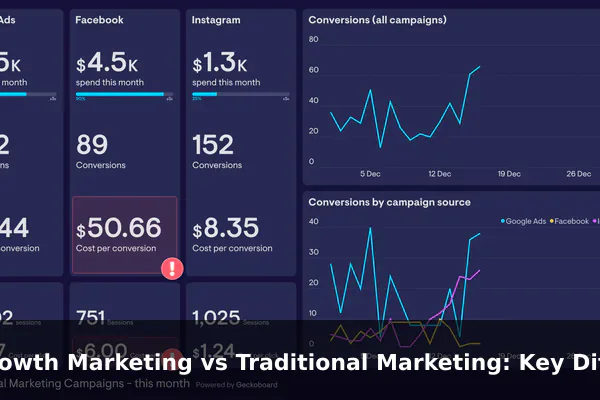
Marketing teams often use the words growth marketing and traditional marketing as if they describe the same job with different labels. They do not. Both aim to help a business grow, but they work in different ways, measure success differently, and usually influence different parts of the customer journey. If you are trying to decide where to spend budget, which team to build, or how to evaluate campaign performance, the distinction matters.
At a simple level, traditional marketing is usually associated with broad awareness, brand visibility, and large campaigns designed to reach a wide audience. Growth marketing, by contrast, is more experimental, more data-driven, and more focused on moving people from first touch to repeat purchase, referral, and long-term value. One approach often asks, How many people saw us? The other asks, What changed in behavior, conversion, retention, and revenue after they saw us?
This comparison matters because different businesses need different engines. A local company entering a crowded market may need credibility and recognition. A startup with limited cash may need fast testing and measurable returns. An established brand may need both: broad awareness at the top and disciplined optimization across the full funnel. Understanding growth marketing vs traditional marketing helps you choose the right tools, metrics, and expectations instead of forcing one model onto every business problem.
What Growth Marketing and Traditional Marketing Actually Mean
Traditional marketing in practical terms
Traditional marketing is the more established approach. It typically focuses on brand awareness, reach, positioning, and message distribution. The main goal is to place a business in front of the right audience often enough that people remember it, trust it, and eventually buy.
Traditional marketing is not limited to offline media, but it is commonly associated with channels such as television, radio, print, direct mail, events, outdoor advertising, and large brand campaigns. Even when it uses digital platforms, its mindset is often campaign-based: define the audience, develop the message, launch the creative, and evaluate results after the campaign runs.
Growth marketing in practical terms
Growth marketing is a more iterative discipline. It focuses on measurable business outcomes across the full customer lifecycle, not just initial exposure. A growth marketer looks at acquisition, activation, retention, referral, and revenue and tries to improve each stage through testing, messaging, product insight, audience segmentation, and conversion optimization.
Instead of treating marketing as a sequence of isolated campaigns, growth marketing treats it as an ongoing system. The team runs experiments, measures results quickly, learns what works, then scales winners and cuts weak ideas. That makes growth marketing closely connected to analytics, landing pages, email flows, onboarding, paid acquisition, CRM systems, and product behavior.
The mindset difference matters more than the channel list
One common mistake is to assume growth marketing means only digital channels while traditional marketing means only offline advertising. That is too simplistic. The deeper difference is the operating model.
- Traditional marketing usually begins with message, reach, and brand presence.
- Growth marketing usually begins with hypotheses, funnel data, customer actions, and optimization opportunities.
- Traditional marketing is often campaign-centered.
- Growth marketing is often experiment-centered.
- Traditional marketing may accept delayed feedback.
- Growth marketing depends on faster feedback loops.
That is why two companies can both advertise online and still operate very differently. One may simply buy impressions and report visibility. The other may test five audience segments, three offers, two landing pages, and a retention sequence, then keep only the combinations that improve customer acquisition cost and lifetime value.
The Core Differences at a Glance
The fastest way to understand growth marketing vs traditional marketing is to compare how each one treats goals, time horizons, channels, and measurement. The table below simplifies the contrast.
| Area | Growth Marketing | Traditional Marketing |
|---|---|---|
| Primary focus | Full funnel growth and measurable conversion improvement | Awareness, reach, reputation, and market presence |
| Typical goal | Acquire, activate, retain, and monetize customers | Build recognition and influence purchase consideration |
| Execution style | Continuous testing and iteration | Planned campaigns with fixed creative periods |
| Common channels | Landing pages, email, paid search, paid social, SEO, onboarding, referral programs | TV, radio, print, outdoor, sponsorships, direct mail, broad brand campaigns |
| Measurement | Conversion rate, CAC, LTV, retention, activation, revenue | Reach, impressions, recall, share of voice, frequency |
| Speed of feedback | Usually fast | Often slower |
| Budget logic | Shift spend based on results | Pre-allocated campaign budgets |
| Audience strategy | Segmented, behavior-based, highly targeted | Broader demographic or mass-market targeting |
| Success view | What behavior changed | How many people were reached and influenced |
Neither column is automatically better. A nationwide consumer brand launching a new product may benefit from traditional marketing because awareness at scale is essential. A software company trying to improve trial-to-paid conversion may benefit more from growth marketing because fine-tuning user behavior produces clearer returns.
Why this distinction is easy to miss
Many businesses mix the two approaches without naming them. A company might run billboard ads for awareness while also optimizing lead forms and email automations for conversion. Because both efforts sit under the same marketing budget, leaders sometimes judge them with the same standards. That creates confusion.
Brand campaigns may look inefficient if you only judge them by immediate conversions. Growth experiments may look too narrow if you only judge them by visibility. Clear strategy requires knowing what each approach is built to do.
How Goals and Metrics Change the Strategy
Traditional marketing goals: awareness, attention, and brand memory
Traditional marketing is often designed to answer top-of-funnel questions:
- How can more people become aware of the brand?
- How can the company shape perception in the market?
- How can it stay visible enough to remain part of purchase consideration?
Because of that, traditional marketing often tracks metrics such as:
- Reach
- Impressions
- Frequency
- Brand recall
- Share of voice
- Audience size
These are useful metrics, especially for large brands, but they do not always reveal what happened after exposure. A campaign can generate high visibility and still produce weak downstream performance if the offer, user experience, or follow-up system is poor.
Growth marketing goals: movement through the funnel
Growth marketing looks for actions that tie more directly to business performance. A common framework is the lifecycle model of acquisition, activation, retention, referral, and revenue. Instead of stopping at the moment a prospect becomes aware, growth marketing asks what happens next and how to improve it.
That leads to a different KPI set:
- Customer acquisition cost
- Conversion rate
- Lead-to-customer rate
- Activation rate
- Repeat purchase rate
- Retention rate
- Average revenue per user
- Lifetime value
- Referral rate
These metrics push teams to build systems, not just campaigns. If retention is weak, the answer may involve onboarding emails, product education, pricing tests, or customer success changes. Growth marketing naturally overlaps with product, sales, and lifecycle communication because it is responsible for more than attention alone.
Strategy changes when the KPI changes
The difference in metrics changes real decisions. Suppose a company is promoting a subscription service.
- A traditional marketing team may invest in a broad awareness campaign to make the brand better known and increase top-of-funnel traffic.
- A growth marketing team may test free trial messaging, shorten the sign-up form, improve onboarding emails, and build a reactivation sequence for users who drop off after week one.
Both are rational. They simply solve different parts of the problem. If the brand is unknown, awareness matters. If traffic is already arriving but few users convert or stay, growth marketing becomes the higher-leverage move.
Channel Selection, Testing, and Campaign Execution
Traditional marketing channels are built for scale and visibility
Traditional marketing tends to favor channels that can deliver broad exposure in a relatively controlled format. These may include:
- Television commercials
- Radio spots
- Print ads
- Outdoor billboards
- Trade show presence
- Sponsorships
- Direct mail
These channels are useful when the goal is to reach many people, build familiarity, and support a brand position over time. They can also be powerful when target buyers are concentrated in a geographic area or specific industry setting.
The tradeoff is that testing can be slower and more expensive. Changing creative, audience selection, or message timing may require longer production cycles and higher fixed costs.
Growth marketing channels are chosen for feedback and optimization
Growth marketing usually favors channels where performance can be tracked and adjusted quickly, including:
- Search ads
- Paid social campaigns
- SEO landing pages
- Email sequences
- Referral programs
- Retargeting ads
- Website personalization
- Conversion-focused content
- In-product messaging
The advantage is not simply that these are digital. The real advantage is that they allow rapid experimentation. A team can test headlines, offers, audiences, pricing angles, calls to action, sign-up flows, and post-conversion nurturing without waiting months for a full campaign cycle to end.
Execution speed changes what a team can learn
Speed is one of the biggest differences between growth marketing and traditional marketing. In a growth model, a team can ask:
- Did page version A or B improve sign-ups?
- Which audience segment delivered the lowest acquisition cost?
- Did a shorter checkout flow increase completed purchases?
- Did customer education reduce early churn?
Because results are measurable and fast, learning compounds. A small improvement in click-through rate, a stronger onboarding email, or a better offer can create a meaningful increase in revenue over time.
Traditional marketing can also generate learning, but it typically does so at a slower cadence. That is not always a weakness. Some brand-building efforts require consistency and repetition, not constant tinkering. The key is to match the execution style to the objective.
Testing is central to growth marketing, optional in traditional marketing
Growth marketing assumes that initial ideas are hypotheses, not final answers. Teams test subject lines, creative angles, pricing language, landing page structure, lead magnets, audience segments, and even product prompts. Over time, the business learns more about what motivates its market.
Traditional marketing may still use research and creative testing, but once a campaign is approved, the core message often stays relatively stable through the media period. That model suits campaigns where consistency, recognition, and polish matter more than daily optimization.
Customer Journey Focus: Awareness vs Full Funnel
Another major difference in growth marketing vs traditional marketing is where each approach concentrates attention in the customer journey.
Traditional marketing often dominates the top of the funnel
Traditional marketing is especially strong at generating initial visibility. It helps people discover a brand, remember its name, and develop a first impression. For many companies, that top-of-funnel role is essential. If nobody knows you exist, conversion optimization alone will not solve the problem.
That is why traditional marketing remains valuable for:
- Category creation
- Brand launches
- Local market entry
- Mass-market promotions
- Reputation and trust building
Its power is less about immediate precision and more about market presence.
Growth marketing works across the entire lifecycle
Growth marketing extends far beyond the first click. It looks at what happens after awareness and often asks harder operational questions:
- What percentage of visitors become leads?
- What percentage of leads become customers?
- How many first-time buyers return?
- What behaviors predict retention?
- What encourages referrals?
This full-funnel view is why growth teams often collaborate closely with sales, product, analytics, and customer success. In many businesses, the biggest revenue opportunity is not getting more traffic but converting existing traffic better or keeping customers longer.
Funnels versus loops
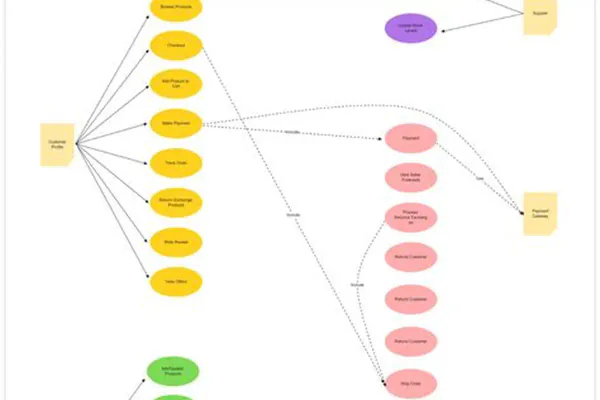
Traditional marketing is commonly visualized as a funnel: awareness leads to interest, then consideration, then purchase. Growth marketing often adds feedback loops. A happy customer refers others. A well-designed onboarding flow increases activation. Better retention improves lifetime value, which allows the business to spend more on acquisition. Each part supports the next.
That systems view is one reason growth marketing has become especially important in subscription businesses, SaaS, ecommerce, apps, and direct-to-consumer brands. These models depend heavily on repeat behavior, not one-time exposure alone.
Pros and Limits of Each Approach
Where traditional marketing performs well
Traditional marketing offers several important strengths:
- Brand building: It is effective for creating familiarity, emotional recognition, and broad market presence.
- Scale: It can reach large audiences quickly, especially in mass markets.
- Credibility: High-visibility placements can make a business appear established and trustworthy.
- Creative impact: Large campaigns can create memorable storytelling that narrow performance ads often cannot.
These strengths matter more than some businesses realize. Not every marketing problem should be solved with a spreadsheet and an A/B test. Trust, perception, and cultural relevance still influence buying behavior.
Where traditional marketing is limited
Its main limitations are equally important:
- Attribution can be weak or delayed.
- Campaign changes can be slow and expensive.
- Budget requirements are often higher.
- Results may be harder to connect directly to revenue.
- It may underinvest in post-acquisition performance.
For a smaller business, that can make traditional marketing feel risky unless the market, audience, and offer are already well understood.
Where growth marketing performs well
Growth marketing brings a different set of strengths:
- Measurability: Performance is easier to track.
- Efficiency: Budget can shift toward the best-performing channels and experiments.
- Adaptability: Teams can change direction quickly when data shows a problem.
- Full-funnel impact: It improves not only acquisition but also retention, monetization, and referrals.
- Scalability through learning: Repeated testing creates knowledge that compounds over time.
This is especially valuable when a company needs to prove return on investment, grow with limited resources, or find product-market traction quickly.
Where growth marketing is limited
Growth marketing is not magic. It also has constraints:
- It can become too tactical if brand strategy is weak.
- It depends heavily on tracking, analytics, and data quality.
- It may optimize for short-term wins at the expense of long-term brand equity.
- It works best when there is enough traffic or user activity to learn from experiments.
- It often requires cross-functional alignment that some organizations lack.
A business can improve conversion rates dramatically and still stall if the market does not trust the brand or if top-of-funnel demand is too small. That is why the smartest decision is often not choosing one side forever, but knowing when each approach should lead.
When to Use Growth Marketing, Traditional Marketing, or Both
Use traditional marketing when market visibility is the real bottleneck
Traditional marketing is often the better lead approach when:
- You are launching into a broad or highly competitive market.
- Your brand lacks recognition or credibility.
- You need geographic awareness at scale.
- Your product benefits from emotional storytelling and repeated exposure.
- Your buying cycle depends heavily on trust before buyers take action.
Examples include established retail brands, local service companies expanding regionally, or consumer products that rely on mass awareness.
Use growth marketing when efficiency and conversion matter most
Growth marketing is often the better lead approach when:
- You already have traffic but weak conversion.
- You need to reduce customer acquisition cost.
- You want to improve trial activation, repeat purchase, or retention.
- You have limited budget and need measurable learning fast.
- Your business model depends on lifetime value, subscriptions, or referrals.
Examples include SaaS products, ecommerce stores, mobile apps, online education businesses, and service companies with trackable lead funnels.
Use both when the business needs awareness and system performance
Many growing companies need both approaches working together. Traditional marketing can create demand and trust. Growth marketing can capture that demand more efficiently and increase the value of every customer acquired.
A balanced strategy might look like this:
- Use broader brand campaigns to increase visibility and interest.
- Direct traffic to conversion-focused landing pages.
- Track behavior and segment audiences.
- Improve activation through email, onboarding, and remarketing.
- Build retention and referral systems to extend customer value.
In that model, traditional marketing fills the top of the pipeline, while growth marketing improves the economics of everything that happens after attention is earned.
A simple decision framework
If you are unsure which approach to prioritize, ask these four questions:
- Is the main problem awareness or conversion? If nobody knows you, awareness comes first. If people know you but do not act, optimization matters more.
- Can you measure downstream behavior clearly? If yes, growth marketing can create faster improvement loops.
- How quickly do you need feedback? Short timelines favor growth tactics. Longer brand-building cycles may justify traditional campaigns.
- What type of value does your business depend on? One-time purchases can lean more heavily on awareness. Repeat-value models benefit strongly from lifecycle growth work.
Key Takeaways for Smarter Marketing Decisions
The debate around growth marketing vs traditional marketing is not really about old versus new. It is about what problem your business is trying to solve. Traditional marketing is excellent at generating visibility, shaping perception, and keeping a brand present in the market. Growth marketing is excellent at turning attention into measurable action and improving performance across the full customer lifecycle.
If your business needs recognition, reach, and credibility, traditional marketing can be the right driver. If your business needs efficient acquisition, better conversion, stronger retention, and clearer ROI, growth marketing will usually deliver more actionable leverage. And if you want durable growth, the strongest answer is often a combination: build the brand broadly, then optimize every step that turns awareness into revenue.
The smartest marketers do not treat these approaches as rivals. They treat them as different tools with different jobs. Once you understand the goals, metrics, channels, and customer journey focus behind each one, you can build a marketing strategy that fits the stage of your business instead of copying someone else's playbook.
In practical terms, that means choosing metrics carefully, matching channels to the real objective, and avoiding the common mistake of expecting every campaign to do everything at once. Awareness campaigns should be judged like awareness campaigns. Growth experiments should be judged like growth experiments. When you separate those roles clearly, your planning becomes sharper, your budget decisions improve, and your marketing becomes easier to scale.
For businesses that want a simple final rule, use this one: traditional marketing creates market presence, while growth marketing improves market performance. Knowing when to emphasize each is what turns marketing activity into a real growth system.
