

Customer Lifetime Value, usually shortened to CLV, is one of the most useful numbers in marketing because it shifts attention away from one-off wins and toward the full economic value of a customer relationship. A campaign might look successful if it drives a large number of first purchases, but that view is incomplete if many of those buyers never return. CLV helps businesses look beyond the first transaction and ask a better question: how much value does a customer create over time?
That makes CLV especially important for companies that want smarter growth instead of expensive growth. When marketers understand customer lifetime value, they can make better decisions about acquisition budgets, retention efforts, loyalty programs, pricing, upsells, and customer experience. It becomes easier to see which customer segments are worth more, which channels bring stronger long-term customers, and where the business is quietly losing value through churn.
In this guide, you will learn what Customer Lifetime Value means in plain English, how the main formula works, how to calculate it step by step, and what the number looks like in real business examples. You will also see how CLV connects to customer acquisition cost, where businesses often make mistakes, and how to improve CLV in ways that actually support long-term profitability.
What Customer Lifetime Value Means
Customer Lifetime Value is the total value a customer brings to a business during the entire relationship. In its simplest form, it estimates how much revenue a customer generates from their first purchase to their last. In a more advanced form, it can measure profit instead of revenue, which gives a more realistic picture of how valuable that customer really is.
CLV in plain English
If one customer buys from a business once and never returns, their lifetime value is low. If another customer buys repeatedly for three years, spends more each time, and costs little to serve, their lifetime value is much higher. CLV captures that difference.
This is why CLV is not just a finance metric. It is a marketing and strategy metric too. It tells you whether you are attracting the right kind of customer, whether your retention efforts are working, and whether your business model supports repeat value.
CLV measures a relationship, not a single sale
Many beginner marketers focus on short-term metrics such as clicks, leads, or even first-time purchases. Those metrics matter, but they only tell part of the story. CLV looks at the whole customer journey. It answers questions such as:
- How often does a customer buy from us?
- How long do they typically stay active?
- How much do they spend over time?
- Do some customer groups create more value than others?
That makes CLV useful for businesses with repeat purchases, subscriptions, memberships, renewals, or any model where customer relationships extend beyond a single transaction.
Revenue CLV and profit CLV are not the same
One common source of confusion is that some businesses calculate CLV based on revenue, while others calculate it based on profit. Revenue-based CLV is easier and faster, so it is often used for basic planning. Profit-based CLV is more accurate because it accounts for margin, service costs, returns, discounts, and other expenses.
Both versions can be useful, but you should know which one you are using. A customer who spends a lot is not automatically a highly valuable customer if their orders come with thin margins or high support costs.
Why CLV Matters in Marketing
Customer Lifetime Value matters because it helps marketers stop judging success by volume alone. More customers is not always better if those customers are expensive to acquire and unlikely to stay. CLV adds quality and durability to performance measurement.
It improves budget decisions
When marketers know the average lifetime value of a customer, they can make better acquisition decisions. If the long-term value of a customer is strong, the business may be able to spend more to acquire that customer without hurting profitability. If CLV is weak, even low acquisition costs might still be too high.
This is one reason CLV is often discussed alongside CAC, or Customer Acquisition Cost. Together, they show whether growth is sustainable or whether a company is buying short-term sales at a long-term loss.
It supports better retention strategy
Retention is often cheaper than acquisition, but many businesses still underinvest in it because its impact is less visible in the short term. CLV helps solve that problem. When you see that improving repeat purchases or reducing churn raises customer value significantly, retention becomes easier to justify.
This can influence decisions such as:
- Whether to invest in loyalty programs
- How much effort to put into onboarding
- Which customer service improvements deserve funding
- When to launch cross-sell and upsell campaigns
It reveals which customers are most valuable
Not all customers are equal. Some spend more frequently, stay longer, refer others, and respond better to premium offers. CLV helps businesses segment customers by long-term value rather than by surface-level activity alone.
That leads to smarter targeting. Instead of treating every lead or buyer the same, marketers can identify the channels, campaigns, products, and behaviors that attract high-value customers. This is where CLV becomes a practical tool for growth, not just an academic formula.
The Basic CLV Formula Explained
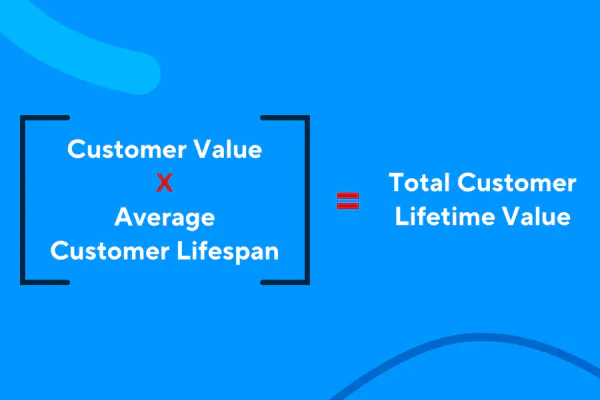
The most common basic formula for Customer Lifetime Value is:
CLV = Average Purchase Value x Average Purchase Frequency x Average Customer Lifespan
This version is simple, useful, and easy for beginners to apply. It estimates how much revenue an average customer generates over the entire relationship with a business.
Average Purchase Value
This is the average amount a customer spends each time they place an order. To calculate it, divide total revenue by the total number of purchases in a given period.
Average Purchase Value = Total Revenue / Total Number of Purchases
If a store makes 20,000 dollars from 500 orders, the average purchase value is 40 dollars.
Average Purchase Frequency
This tells you how often the average customer buys during a chosen period. A simple version is:
Purchase Frequency = Total Number of Purchases / Total Number of Customers
If 500 orders come from 200 customers, the average purchase frequency is 2.5 purchases per customer during that period.
Average Customer Lifespan
This is the average length of time a customer continues buying from the business. Depending on the company, lifespan may be measured in months or years. A subscription business might use months. A retailer with slower buying cycles may use years.
If a typical customer remains active for 3 years, then the lifespan input in the formula is 3.
Putting the formula together
Once you have all three values, multiply them:
CLV = 40 x 2.5 x 3 = 300
That means the average customer is worth 300 dollars in revenue over the full relationship.
When to add margin
If you want a more realistic business view, you can adjust the formula to include gross margin:
Margin-Based CLV = Average Purchase Value x Purchase Frequency x Customer Lifespan x Gross Margin
This matters because 300 dollars in revenue does not mean 300 dollars in profit. If your gross margin is 50 percent, the value that remains after direct costs is closer to 150 dollars.
How to Calculate CLV Step by Step
Many people understand the formula in theory but get stuck when turning it into a real number. The easiest solution is to calculate CLV in a clear sequence and use data from one consistent period.
Step 1: Choose your time frame
Start with a clean reporting period such as the last 12 months. A year is often a practical choice because it captures seasonality better than a single month or quarter.
Step 2: Find total revenue and total purchases
Pull the total revenue generated during that time frame and the total number of completed purchases. These numbers usually come from your e-commerce platform, CRM, billing system, POS, or accounting software.
Step 3: Calculate average purchase value
Divide total revenue by total purchases. This tells you the average amount spent per transaction.
Step 4: Calculate purchase frequency
Divide total purchases by the total number of unique customers in the same period. This gives you the average number of purchases per customer.
Step 5: Estimate average lifespan
Use historical customer data to estimate how long customers remain active. For simple models, businesses often use an average number of years. Subscription companies may estimate lifespan using churn patterns.
Step 6: Multiply the values
Multiply average purchase value by purchase frequency and by lifespan. If needed, multiply by gross margin as a final adjustment.
Where businesses usually get the data
- E-commerce platform: orders, revenue, repeat purchase behavior
- CRM: customer records, cohorts, purchase history
- Billing or subscription tools: renewals, churn, monthly recurring revenue
- POS systems: in-store transactions and customer frequency
- Analytics dashboards: acquisition source and segment comparisons
A practical note about averages
Basic CLV uses averages, which makes it accessible but imperfect. Real customers do not behave identically. Some buy once, others buy ten times, and some become inactive quickly. That is why basic CLV is best treated as a directional business metric, not a promise about every customer.
If you want a better result, calculate CLV by segment. For example, compare email subscribers with paid social customers, or compare first-time discount buyers with full-price repeat buyers. That gives you a more actionable view than one broad average across the whole customer base.
Customer Lifetime Value Examples
Examples make CLV easier to understand because the formula changes depending on the business model. The core logic stays the same, but the data behaves differently in retail, subscription, and service businesses.
Example 1: E-commerce store
Imagine an online skincare store with the following data:
- Total annual revenue: 120,000 dollars
- Total annual orders: 3,000
- Total customers: 1,000
- Average customer lifespan: 2 years
First, calculate average purchase value:
120,000 / 3,000 = 40 dollars
Next, calculate purchase frequency:
3,000 / 1,000 = 3 purchases per customer
Now apply the formula:
CLV = 40 x 3 x 2 = 240 dollars
That means the average customer generates 240 dollars in revenue over the relationship. If the store’s gross margin is 60 percent, the margin-based CLV would be:
240 x 0.60 = 144 dollars
This number is much more useful when deciding how much to spend on acquisition.
Example 2: Subscription business
Now consider a software subscription priced at 30 dollars per month. The average customer stays for 18 months.
A rough subscription-style CLV can be calculated like this:
CLV = Monthly Revenue per Customer x Average Lifespan in Months
CLV = 30 x 18 = 540 dollars
If the company keeps a 70 percent gross margin, the margin-based value becomes:
540 x 0.70 = 378 dollars
This simple model works well when revenue is recurring and predictable. More advanced subscription teams may also use churn-based formulas and discount future cash flows, but the basic version is often enough for practical marketing decisions.
Example 3: Service business
Suppose a small accounting firm serves local business clients:
- Average monthly retainer: 500 dollars
- Average client lifespan: 24 months
- Gross margin: 50 percent
The revenue-based CLV is:
500 x 24 = 12,000 dollars
The margin-based CLV is:
12,000 x 0.50 = 6,000 dollars
This example shows why CLV can be dramatically different across industries. A service client may be fewer in number than retail customers, but each one can be worth far more over time.
What these examples teach
CLV is not about finding one universal benchmark. It is about understanding the economics of your business model. A low-ticket e-commerce brand, a subscription platform, and a service firm can all use CLV effectively, but the interpretation must fit the way customers buy.
CLV vs Customer Acquisition Cost
Customer Lifetime Value becomes far more useful when paired with Customer Acquisition Cost (CAC). CAC tells you how much it costs to acquire a new customer. CLV tells you how much value that customer generates over time. The relationship between the two helps answer one of the most important business questions: is growth profitable?
Why the comparison matters
If it costs 100 dollars to acquire a customer and that customer only produces 80 dollars in lifetime value, the business is losing money before overhead is even considered. If that same customer produces 300 dollars in value, the economics look very different.
This comparison helps marketers decide:
- Whether acquisition channels are sustainable
- Whether payback periods are too long
- Whether retention improvements could justify higher acquisition spend
- Which segments deserve larger budgets
A simple ratio
Many teams use a CLV:CAC ratio. For example:
CLV of 300 dollars / CAC of 100 dollars = 3:1 ratio
A 3:1 ratio is often treated as a healthy starting point, but it is not a law. Industry norms, margins, cash flow, growth stage, and operating costs all affect what counts as sustainable.
Why a high ratio is not always perfect
A very high CLV:CAC ratio can look excellent, but it may also signal underinvestment in growth. If a company acquires customers very cheaply and earns strong lifetime value from them, there may be room to scale faster. On the other hand, a weak ratio may mean poor targeting, weak retention, low pricing power, or an inefficient sales process.
The real benefit of CLV and CAC together is that they turn marketing from a cost center into a system of measurable unit economics.
How to Improve Customer Lifetime Value
Improving CLV usually comes down to three levers: getting customers to spend more, buy more often, or stay longer. The strongest businesses work on all three instead of relying on acquisition alone.
Increase average order value
If customers spend more per purchase, CLV rises even if purchase frequency stays the same. Practical ways to do this include:
- Bundling related products
- Offering premium versions
- Using thoughtful upsells at checkout
- Setting free shipping thresholds that encourage slightly larger baskets
The key is relevance. Aggressive upselling can hurt trust, while useful upgrades can raise value without increasing friction.
Increase purchase frequency
Some businesses have decent first-order performance but weak repeat behavior. In those cases, the biggest CLV opportunity is to create more reasons to return. Tactics may include:
- Email sequences tied to replenishment timing
- Personalized product recommendations
- Loyalty points or reward programs
- Post-purchase education that helps customers get better results
Frequency improves when the next purchase feels natural, timely, and beneficial.
Extend customer lifespan
For subscription and service businesses, reducing churn has an outsized effect on CLV. Even a small increase in retention can meaningfully improve total customer value. This often depends on:
- Better onboarding
- Faster time to value
- Clear communication
- Responsive support
- Proactive account management
Customers stay longer when they consistently feel that the product or service solves an important problem.
Improve customer experience
Customer experience is not separate from CLV. It is one of the drivers behind it. Confusing checkout flows, poor packaging, broken onboarding, slow support, or weak product education can all reduce repeat behavior. A better experience raises trust, lowers friction, and makes future purchases more likely.
Focus on better-fit customers
Sometimes the best way to improve CLV is not to squeeze more value from every customer. It is to attract customers who are a better long-term fit in the first place. That might mean adjusting your messaging, refining your offer, or shifting budget toward channels that bring higher-retention buyers instead of bargain hunters who disappear after one sale.
Common CLV Mistakes to Avoid
CLV is powerful, but it is easy to misuse. A number that looks precise can still be misleading if the inputs or assumptions are weak.
Using revenue and calling it profit
This is one of the most common mistakes. Revenue-based CLV is fine as long as it is labeled correctly. Problems start when businesses treat revenue as if it were profit and base spending decisions on overly optimistic numbers.
Ignoring segment differences
An overall average can hide major differences between customer groups. Some channels may bring high-CLV customers while others bring low-value one-time buyers. If you only track one blended CLV figure, you may miss those patterns.
Relying on weak lifespan estimates
Lifespan is often the hardest variable to estimate, especially for younger businesses with limited history. If the lifespan number is too generous, CLV will be inflated. In those cases, use conservative assumptions and update them as better data becomes available.
Forgetting margin and service costs
High-spending customers are not always highly profitable customers. Returns, support demands, fulfillment costs, and discounting can reduce real value. Businesses that ignore these factors may overpay to acquire customers who only look attractive on paper.
Thinking CLV is static
Customer Lifetime Value changes over time. Pricing changes, retention programs improve, product mix shifts, and acquisition channels evolve. CLV should be reviewed regularly, not treated as a permanent number that never needs adjustment.
When to Use Basic vs Advanced CLV Models
The basic CLV formula is enough for many small and mid-sized businesses. It is clear, fast, and useful for planning. But it has limits, especially when customer behavior is complex.
When a basic model is enough
Use a basic CLV model when:
- You need a practical planning metric quickly
- Your business has straightforward repeat purchase behavior
- You are comparing broad channels or campaigns
- You do not yet have enough clean data for deeper modeling
For many marketers, this is the right starting point. A simple, honest CLV is better than a sophisticated model built on poor data.
When advanced CLV models make sense
Advanced models become valuable when:
- You have large customer cohorts with different behaviors
- You run a subscription business with meaningful churn patterns
- You want to predict future value instead of summarizing past value
- You need to factor in margins, discount rates, and service costs
Examples of advanced approaches include cohort-based CLV, predictive CLV, churn-based subscription models, and discounted cash flow models. These methods are useful, but they are only worth the effort when the business has enough reliable data and a real need for more precision.
In other words, start simple, make decisions, improve your data, and then add complexity only when it creates better decisions.
Conclusion
Customer Lifetime Value is one of the clearest ways to understand the long-term strength of a business. It shows how much value customers create over the full relationship, not just at the first sale. That makes it essential for evaluating marketing performance, retention strategy, customer quality, and sustainable growth.
The core formula is simple: average purchase value multiplied by purchase frequency multiplied by average customer lifespan. From there, businesses can refine the number by adding margin, segmenting customer groups, and comparing CLV with CAC. The result is a more practical view of how marketing contributes to profitability.
If you want to use CLV effectively, do not treat it as a theoretical metric for reports alone. Use it to guide real decisions. Look at which customers stay, which channels attract them, what increases repeat purchases, and where churn quietly destroys value. That is where Customer Lifetime Value becomes more than a formula. It becomes a framework for smarter marketing.
