

Conversion rate is one of the most useful numbers in marketing because it turns activity into meaning. Traffic, clicks, and impressions can tell you whether people noticed your message, but conversion rate tells you whether they actually did what you wanted them to do. That makes it one of the clearest ways to judge whether a page, campaign, or offer is working.
At a basic level, conversion rate shows the percentage of people who complete a desired action. That action could be a purchase, a demo request, an email sign-up, a file download, or even a booked call. The idea sounds simple, but many beginners misuse the metric by counting the wrong audience, picking the wrong action, or comparing numbers that do not mean the same thing.
This guide explains conversion rate in plain English, walks through the exact formula, and shows clear examples across different marketing situations. It also covers what a good conversion rate really means, how to improve it, and which mistakes can quietly distort your reporting.
What Conversion Rate Means in Marketing
Conversion rate is the percentage of people who take a desired action out of the total number of people who had the chance to take that action. In marketing, that desired action is called a conversion.
A conversion does not always mean a sale. It means the action that matches your current business goal. For an online store, the conversion may be a completed order. For a software company, it may be a free trial sign-up. For a consultant, it may be a form submission from a qualified lead. For a content site, it may be a newsletter subscription.
Different actions can count as conversions
One reason conversion rate matters so much is that it works across many business models. The action changes, but the logic stays the same.
- Ecommerce: a visitor buys a product.
- Lead generation: a visitor fills out a contact form.
- SaaS: a user starts a free trial or books a demo.
- Email marketing: a recipient clicks and later purchases.
- Mobile apps: a user installs the app or upgrades to paid.
- Content marketing: a reader downloads a guide or joins a list.
Why marketers care about conversion rate
Conversion rate helps answer a practical question: Are we turning attention into action? A campaign may attract a large audience, but if very few people convert, something is broken. The issue could be weak messaging, poor audience targeting, unclear value, bad timing, a slow page, or too much friction in the process.
This is why conversion rate is not just a reporting metric. It is a decision metric. It helps marketers decide where to improve copy, design, offer quality, targeting, and user experience. A higher conversion rate usually means you are making better use of the traffic you already have.
Micro conversions and macro conversions
It also helps to separate micro conversions from macro conversions. A micro conversion is a smaller step that shows interest, such as clicking a pricing page, adding a product to cart, or subscribing to a newsletter. A macro conversion is the main business goal, such as a purchase or signed contract.
This distinction matters because a page can have strong micro conversion activity but weak final results. For example, many people may add a product to cart, but far fewer may complete checkout. In that case, the problem is not interest. The problem is likely in the final step.
The Conversion Rate Formula Explained
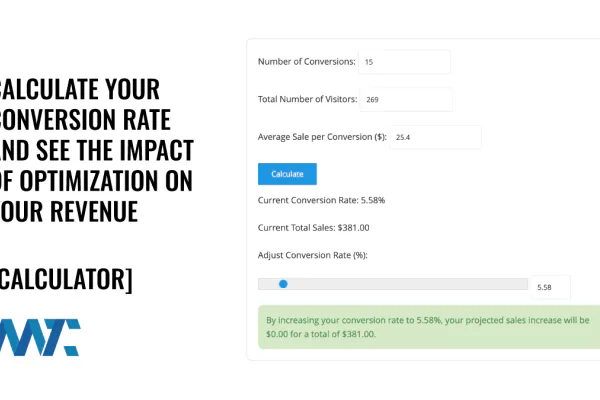
The standard formula is straightforward:
Conversion Rate = (Number of Conversions / Total Number of People Exposed to the Opportunity) x 100
Most of the confusion comes from the denominator, not the formula itself. The top number is usually easy: count how many conversions happened. The bottom number requires more care because it depends on what exactly you are measuring.
The numerator: number of conversions
The numerator is the total number of completed actions. If 25 people bought a product, the numerator is 25. If 80 people filled out a demo form, the numerator is 80.
This number only works if your tracking is clear. If your analytics tool counts duplicate conversions, partial actions, or unqualified leads as full conversions, your conversion rate will look better than it really is. That is why a clean definition comes before a clean formula.
The denominator: who had the chance to convert
The denominator should reflect the group that had a real opportunity to take the action. Depending on the context, that group might be visitors, sessions, clicks, recipients, or users.
- Website visitor conversion rate: conversions divided by visitors.
- Session conversion rate: conversions divided by sessions.
- Landing page conversion rate: form submissions divided by landing page visitors.
- Email conversion rate: purchases divided by delivered emails or by clicks, depending on the question.
- Paid ad conversion rate: conversions divided by ad clicks if you are measuring post-click performance.
None of these are automatically wrong. The important part is to label the metric correctly and stay consistent when you compare results over time.
Visitors, sessions, clicks, and recipients are not the same
A visitor usually means a unique person. A session means a visit, and one person can create multiple sessions. A click means someone clicked an ad, email link, or button. A recipient means someone received a message, such as an email.
If you switch between these denominators without explaining it, your conversion rate becomes misleading. For example, 100 conversions from 2,000 email recipients is 5 percent, but 100 conversions from 400 clicks is 25 percent. Both numbers can be true at the same time, yet they answer different questions.
Why denominator choice changes the meaning
This is the most useful way to think about conversion rate: the formula is simple, but the business meaning depends on the denominator.
If you divide by all visitors, you are measuring how efficiently a page turns traffic into action. If you divide by clicks, you are measuring how well the destination experience converts already interested users. If you divide by email recipients, you are measuring the whole email program, including subject line, audience quality, and offer strength.
In other words, conversion rate is not just one number. It is a lens. The denominator tells you which part of the process you are evaluating.
How to Calculate Conversion Rate Step by Step
Once you define the conversion and choose the right audience, calculating conversion rate is easy.
- Choose the action you want to measure, such as purchases, sign-ups, or form completions.
- Count the total conversions during a specific time period.
- Choose the relevant denominator such as visitors, sessions, clicks, or recipients.
- Divide conversions by the denominator.
- Multiply by 100 to turn the result into a percentage.
Step-by-step website example
Imagine an online store had 5,000 visitors in one month and 150 completed purchases.
The formula would be:
150 / 5,000 x 100 = 3%
That means the store’s conversion rate is 3 percent. Out of every 100 visitors, about 3 completed a purchase.
Step-by-step lead generation example
Now imagine a consulting company sends traffic to a landing page. The page gets 1,200 visitors, and 72 people submit the contact form.
72 / 1,200 x 100 = 6%
The landing page conversion rate is 6 percent. This is not automatically better than the ecommerce example above because the action is different. A form fill usually requires less commitment than paying for a product.
Step-by-step email example
An email campaign is sent to 10,000 subscribers. Of those recipients, 300 buy a featured product.
300 / 10,000 x 100 = 3%
The email conversion rate is 3 percent if you measure against delivered emails. But suppose 1,500 people clicked the email and 300 bought. Then the post-click conversion rate would be:
300 / 1,500 x 100 = 20%
Again, both figures can be useful. One measures the full email campaign. The other measures how well the landing page converted people who already showed interest.
A simple checklist before you report the number
- Use the same date range for conversions and traffic.
- Make sure the conversion action is fully completed, not just started.
- State whether you used visitors, sessions, clicks, or recipients.
- Do not compare rates from different denominators as if they are identical.
- Check for tracking errors before sharing the result.
Clear Examples Across Different Channels
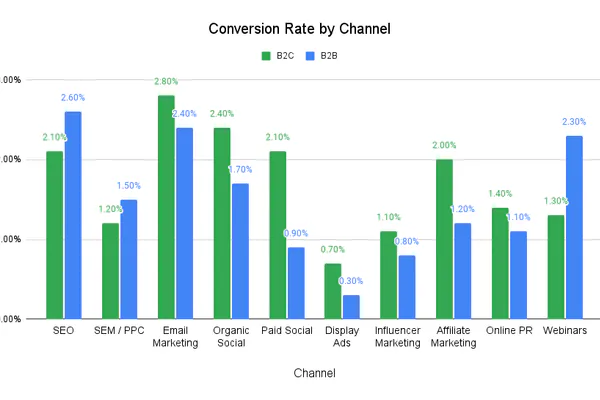
Conversion rate becomes more useful when you see how it works in real marketing situations. The examples below show the same metric in different environments, which is where many beginners start to understand its flexibility.
Ecommerce product page example
A product page receives 8,000 visitors in April. During that month, 160 orders come from that page.
160 / 8,000 x 100 = 2%
The page has a 2 percent conversion rate. If the business wants to improve it, the likely areas to review include product images, trust signals, shipping transparency, page speed, mobile layout, pricing clarity, and checkout friction.
Landing page sign-up example
A webinar landing page gets 2,500 visitors and generates 250 registrations.
250 / 2,500 x 100 = 10%
That 10 percent rate reflects how well the page converts targeted traffic into sign-ups. If registrations are lower than expected, the team might test the headline, shorten the form, clarify the event benefit, or make the call to action more obvious.
Email campaign example
A retailer sends a promotion to 20,000 subscribers. The email generates 600 purchases.
600 / 20,000 x 100 = 3%
If 3,000 subscribers clicked through to the offer, then the click-to-purchase conversion rate is:
600 / 3,000 x 100 = 20%
This tells a richer story. A strong post-click rate may suggest the landing page is good, while a lower recipient-level rate may suggest the subject line, list quality, or send timing needs work.
Paid ad example
A paid search campaign generates 4,000 clicks, and 120 of those clicks result in free trial sign-ups.
120 / 4,000 x 100 = 3%
This means the campaign’s post-click conversion rate is 3 percent. If cost per click rises but conversion rate stays strong, the campaign may still be profitable. If clicks are cheap but conversion rate is weak, the traffic may be low intent or the offer may not match the ad promise.
App install example
A mobile app page receives 15,000 store visitors and generates 1,050 installs.
1,050 / 15,000 x 100 = 7%
Here, conversion rate helps the team judge whether the app title, screenshots, ratings, description, and positioning are convincing enough to turn attention into downloads.
Why the same percentage can mean different things
A 5 percent conversion rate is not universally good or bad. Five percent for a low-cost email offer means something different from 5 percent for enterprise software demos. The more expensive, complex, or high-commitment the action, the lower the rate may be without signaling a problem.
That is why smart marketers avoid asking only, What is our conversion rate? A better question is, What is our conversion rate for this audience, on this channel, for this offer, with this level of buying intent?
What Counts as a Good Conversion Rate
There is no single universal benchmark for a good conversion rate. The right standard depends on the type of business, the source of traffic, the price of the offer, and how much commitment the conversion requires.
Intent matters more than averages
Traffic from a branded search term usually converts differently from traffic coming from a cold display ad. Someone who actively searched for your brand or product category already has stronger intent than someone who simply noticed an ad while browsing.
This means a lower rate is not always a sign of poor performance. It may reflect colder traffic at the top of the journey. Likewise, a higher rate is not always impressive if the audience was already highly qualified.
Offer strength changes the benchmark
Free downloads, email subscriptions, and webinar registrations often convert at a higher rate than paid purchases because they require less risk. A premium consulting engagement or enterprise software contract will usually convert at a lower rate because the decision is bigger.
When evaluating performance, compare like with like. Compare the same offer type, the same audience type, and the same traffic source before drawing conclusions.
Channel quality affects the result
- Organic search may convert well when the content matches a high-intent query.
- Email traffic often converts well because the audience already knows the brand.
- Paid social traffic may convert lower if the audience is less ready to act.
- Referral traffic can vary widely depending on where the recommendation came from.
Use your own baseline first
For most businesses, the most practical benchmark is your own historical performance. If your landing page moved from 3 percent to 4.5 percent after a redesign, that improvement matters even if another company somewhere reports a higher average.
Internal trend lines are often more useful than generic industry averages because they reflect your actual traffic mix, product, pricing, and market position.
How to Improve Conversion Rate
Improving conversion rate is often more efficient than buying more traffic. When you convert more of the visitors you already have, you increase the return on existing marketing effort without automatically increasing ad spend.
1. Clarify the value proposition
People convert when they quickly understand what you offer, who it is for, and why it is worth acting on now. If your headline is vague, your page may get attention without generating action.
A clear value proposition should explain the benefit in simple language. It should answer the visitor’s most basic question: What do I get if I do this?
2. Reduce friction
Every extra step lowers the chance of conversion. Long forms, confusing checkouts, forced account creation, hidden fees, and slow load times all create friction.
- Remove unnecessary form fields.
- Shorten the checkout path.
- Make buttons easy to find.
- Show total costs early.
- Improve page speed, especially on mobile.
3. Match the message to the traffic source
If an ad promises one thing but the landing page emphasizes something else, visitors feel a disconnect. That weakens trust and lowers conversion rate.
Strong conversion performance usually comes from good message match. The headline, visuals, offer, and call to action should feel like a natural continuation of the ad, email, search result, or social post that brought the visitor there.
4. Build trust before asking for action
People hesitate when they are unsure whether a business is credible. Reviews, testimonials, guarantees, client logos, return policies, security cues, and transparent contact details can reduce that hesitation.
Trust is especially important when the offer involves money, personal information, or a longer-term commitment.
5. Optimize for mobile behavior
Many businesses still lose conversions because their pages look acceptable on desktop but frustrating on phones. Small buttons, cramped forms, hard-to-read text, intrusive pop-ups, and slow loading can quietly damage performance.
Since a large share of traffic is mobile, conversion rate improvement often starts with mobile usability rather than more persuasive copy alone.
6. Test one meaningful change at a time
Conversion rate optimization works best when changes are deliberate. Test a stronger headline, a shorter form, a different offer, or a clearer button label. If you change everything at once, you may improve results without learning why.
Simple tests are often enough to reveal major friction points. The goal is not endless experimentation. The goal is a cleaner path to action.
7. Improve traffic quality, not just page design
Sometimes the page is not the problem. Weak conversion rate can come from attracting the wrong audience. If traffic is low intent, poorly targeted, or based on misleading creative, even an excellent page may struggle.
This is an important point many teams miss: conversion rate improvement is not only about page optimization. It is also about bringing the right people in the first place.
Common Conversion Rate Mistakes to Avoid
Because conversion rate looks simple, it is easy to use it badly. The most common errors are not mathematical. They are strategic and definitional.
Tracking a weak action as if it were the main goal
If you celebrate a high conversion rate for a low-value action, you may create a false sense of success. For example, a page may generate many email sign-ups but very few qualified leads or customers. The rate looks strong, but the business outcome is weak.
Always ask whether the conversion being measured is actually tied to value.
Using inconsistent denominators
Comparing a visitor-based conversion rate this month with a click-based rate next month makes the trend unreliable. The numbers may look comparable, but they describe different realities.
Label your metric clearly and keep the denominator stable when reporting performance over time.
Ignoring sample size
A conversion rate from 20 visitors tells you very little. Small numbers can swing dramatically due to random variation. If one extra conversion changes the rate by several percentage points, the data is still fragile.
Before making major decisions, make sure the sample size is large enough to support the conclusion.
Comparing mismatched time periods or traffic mixes
A holiday campaign, a product launch week, and a normal month are not equal conditions. Neither are traffic sources with very different intent levels. If you compare mismatched periods or audiences, you may misread what caused the change.
Good analysis controls for context. Compare similar time frames and similar channel conditions whenever possible.
Focusing on rate while ignoring volume and quality
A page with a 12 percent conversion rate from 100 visitors may generate fewer real results than a page with a 4 percent conversion rate from 10,000 visitors. Likewise, a higher rate is not necessarily better if the leads are unqualified or the purchases come from heavy discounting that harms margin.
Conversion rate should be used with business judgment. It is powerful, but it is not the only metric that matters.
Key Takeaways for Using Conversion Rate Well
Conversion rate becomes far more useful when you treat it as a precise measurement, not a generic marketing buzzword. The biggest gains usually come from defining the conversion clearly, choosing the right denominator, and understanding what stage of the journey the metric is actually measuring.
- Conversion rate is the percentage of people who complete a desired action.
- The formula is conversions divided by the relevant audience, multiplied by 100.
- The denominator matters because visitors, sessions, clicks, and recipients answer different questions.
- Examples vary by channel, so a good rate depends on the type of offer, traffic source, and level of intent.
- Improvement comes from clarity, trust, lower friction, better targeting, and smart testing.
- Bad reporting usually starts with bad definitions, not bad arithmetic.
Conclusion
Conversion rate is one of the clearest ways to measure whether marketing is producing action instead of just attention. When used properly, it helps businesses evaluate pages, campaigns, offers, and traffic sources with far more precision than raw visitor counts alone.
The most important habit is to define the conversion carefully and match the formula to the situation. Once that foundation is in place, conversion rate becomes a practical tool for better decisions, better optimization, and stronger marketing performance over time.
