
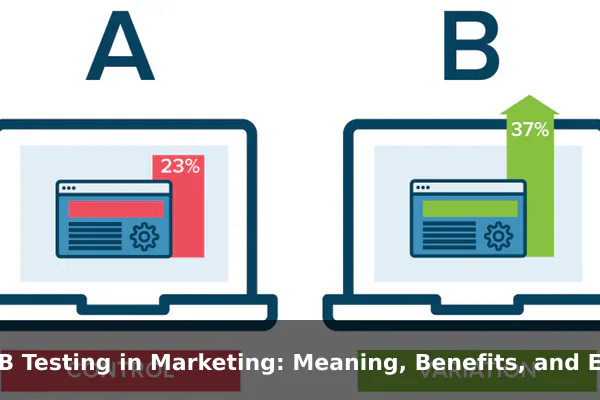
Marketing teams make decisions every day about headlines, images, offers, forms, button text, ad creative, and page layouts. The problem is that many of those decisions are easy to debate and hard to prove. One person prefers a shorter headline, another prefers a brighter button, and someone else believes a longer form will bring in better leads. A/B testing gives marketers a practical way to replace opinions with evidence.
At its simplest, A/B testing is a method for comparing two versions of the same marketing asset to see which one performs better. Instead of guessing what your audience will respond to, you show version A to one group and version B to another, then measure what happens. That makes A/B testing one of the most useful tools in modern marketing because it helps teams improve results without relying on instinct alone.
This matters far beyond a single campaign. A well-run test can improve conversion rates, reduce wasted budget, uncover audience preferences, and build a habit of smarter decision-making. In this guide, you will learn what A/B testing means in marketing, how it works step by step, why it matters, what elements you can test, and how brands use it in real marketing situations across email, ads, landing pages, and ecommerce.
What A/B Testing Means in Marketing

A simple definition
A/B testing in marketing, also called split testing, is the process of comparing two versions of a marketing element to determine which version produces a better result. Version A is usually the current or control version. Version B is the variation with one intentional change. The change might be a different subject line, a new call-to-action, a revised hero image, or a simpler form.
The goal is not to prove that one design looks better. The goal is to measure which version performs better against a clear business metric. Depending on the campaign, that metric could be clicks, sign-ups, purchases, demo requests, add-to-cart rate, or revenue per visitor.
Why marketers use version A and version B
Marketers use the A-versus-B format because it creates a controlled comparison. If both versions run under similar conditions and the audience is split fairly, the result becomes much easier to interpret. Instead of changing five things and hoping for the best, you isolate one meaningful difference and evaluate its impact.
That is what makes A/B testing different from ordinary experimentation. It is not random trial and error. It is a structured way to answer a specific question such as, Will a benefit-driven headline generate more sign-ups than a feature-driven headline? or Will a shorter checkout form reduce abandonment?
A/B testing is really a decision system
One useful way to think about A/B testing is that it is not just a tactic for improving a single asset. It is a decision system for marketing. Over time, each test adds to your understanding of what your audience values, what kind of message lowers friction, and what kinds of offers attract higher-intent customers. In that sense, A/B testing helps marketers build a repeatable learning process, not just occasional conversion wins.
How A/B Testing Works Step by Step
1. Start with one clear question
Every useful A/B test begins with a focused question. For example, you may want to know whether a free-trial offer outperforms a discount offer on a pricing page. A narrow question prevents the test from turning into a vague redesign project.
Strong tests usually come from a real performance issue. If your ad gets impressions but not clicks, you may need to test the headline or image. If your landing page gets traffic but not form submissions, you may need to test the page message, proof points, or form length.
2. Form a hypothesis
A hypothesis is a short statement about what you expect to happen and why. For example: Changing the CTA from “Learn More” to “Get My Free Quote” will increase clicks because it is more specific and outcome-focused. A hypothesis matters because it forces the team to think about user behavior rather than making random edits.
Without a hypothesis, it is easy to run disconnected tests that generate numbers but not insight. With one, even a losing test can teach you something useful about audience intent.
3. Choose one variable to test
In a standard A/B test, you typically change one main variable at a time. That might be the headline, image, button color, button text, price presentation, or layout. Keeping the test focused makes the outcome easier to trust. If you change too many things at once, you may see a difference in results but still not know what caused it.
There are situations where broader experiments are useful, but for most marketers, one-variable testing produces clearer learning and makes future improvements easier to plan.
4. Split the audience
Next, you divide the audience so one group sees version A and another group sees version B. In digital tools, this usually happens automatically. The critical point is fairness: both versions should be shown to comparable audiences during the same general time period so the comparison reflects the test itself rather than outside conditions.
If one version runs during a holiday promotion and the other runs after the campaign ends, the results may be distorted. A/B testing works best when the environment around both versions is as similar as possible.
5. Track the right metric
The winning version should be determined by a primary KPI, not by whatever number looks impressive afterward. If you are testing an email subject line, the primary KPI may be open rate. If you are testing a landing page, it may be conversion rate. If you are testing checkout design, it may be completed purchases.
Secondary metrics can still help. A version may get more clicks but attract lower-quality leads. That is why it is often smart to monitor the full path, not just the first action.
6. Run the test long enough to learn
A/B tests need enough traffic and enough time to produce useful information. Ending too early is one of the fastest ways to make a bad decision. Early results often swing up and down. A test that looks like a clear winner after one day may lose its advantage after a week.
You do not need to become a statistician to benefit from testing, but you do need enough data to avoid reading noise as truth. In practice, that means setting a sensible testing window and resisting the temptation to stop the test the moment one version pulls ahead.
7. Apply the result and document the learning
After the test ends, the winning variation can become the new default. But the work should not stop there. The real value comes from documenting what you tested, why you tested it, what happened, and what you learned. That record prevents teams from repeating weak ideas and helps them identify patterns over time.
For example, you may find that specific, action-oriented copy consistently beats generic wording across several channels. That insight can influence future email campaigns, ads, product pages, and lead capture forms.
Why A/B Testing Matters for Marketers
It improves conversion rates
The most obvious benefit of A/B testing is that it can improve results without increasing traffic. If you already have visitors, subscribers, or ad impressions, even a small lift in conversions can create significant business value. Improving a landing page from 3% to 4% may sound modest, but over time it can mean many more leads or sales from the same budget.
It reduces guesswork and internal debate
Marketing decisions often become subjective, especially when teams are reviewing copy or design. A/B testing creates a more objective standard. Instead of arguing over preferences, the team can ask, What did the audience respond to? That shift saves time and leads to stronger decisions.
It lowers risk
Making a major change across an entire campaign can be risky. A/B testing reduces that risk by allowing you to validate a change on a smaller scale before rolling it out more broadly. This is especially useful when testing pricing presentation, lead forms, new offers, or onboarding messages that directly affect revenue.
It reveals audience behavior
Good tests do more than produce a winner. They show what matters to your audience. Maybe prospects respond better to speed than savings. Maybe buyers prefer social proof near the CTA instead of at the bottom of the page. Maybe a shorter form attracts more sign-ups, but a slightly longer form brings in better-qualified leads. These insights make your future marketing sharper.
It supports continuous improvement
One of the strongest long-term benefits of A/B testing is cultural. Teams that test regularly tend to become more disciplined, more curious, and more evidence-driven. Instead of looking for one perfect campaign, they treat marketing as an ongoing process of improvement. That mindset is often more valuable than any single test result.
Elements You Can Test
A/B testing can be applied across many parts of the customer journey. The exact variable depends on where friction appears and what action you want the audience to take. Common test elements include:
- Headlines: benefit-driven vs feature-driven language
- Email subject lines: curiosity-based vs direct wording
- CTA buttons: generic text vs action-specific text
- Images: product-focused visuals vs lifestyle visuals
- Page layouts: short-form pages vs longer explanatory pages
- Ad copy: emotional messaging vs rational messaging
- Offers: free trial vs discount vs demo request
- Forms: fewer fields vs more qualifying fields
- Pricing presentation: monthly framing vs annual savings framing
- Social proof: testimonials, reviews, badges, or case study placement
Not every test needs to be dramatic. Sometimes small wording changes matter. Other times a minor cosmetic change has little impact and the real improvement comes from testing a stronger offer or clearer value proposition. In general, the best things to test are the elements most likely to affect decision-making, not just appearance.
Examples of A/B Testing in Real Marketing Scenarios
Email marketing example
An email team wants to improve open rates for a weekly newsletter. Version A uses the subject line New Marketing Tips for This Week. Version B uses 3 Quick Marketing Fixes You Can Use Today. Both emails contain the same content. If version B gets a meaningfully higher open rate, the team learns that specificity and immediacy may be more compelling than a broad subject line.
The team can then apply that insight to future campaigns instead of treating the result as a one-time win.
Landing page example
A SaaS company is driving paid traffic to a free-demo page. Version A opens with product features. Version B opens with a simple outcome-focused headline, a short benefits list, and a customer proof statement above the form. If version B produces more demo requests, the likely lesson is that visitors need a clear business outcome and trust signal before they are ready to take action.
This example shows why A/B testing is not only about design details. Often the biggest gains come from improving message clarity and reducing friction.
Paid advertising example
A retailer runs two search or display ads to promote the same product category. Version A emphasizes price with copy such as Save 20% Today. Version B emphasizes convenience with copy such as Delivered Fast to Your Door. If the convenience angle drives more qualified clicks and better sales, the company learns that its audience values speed more than discounts in that context.
That insight can inform future ad copy, landing pages, and even merchandising language.
Ecommerce product page example
An ecommerce store wants to increase add-to-cart rate on a high-volume product page. Version A shows a standard product description and reviews farther down the page. Version B moves key reviews, shipping reassurance, and return information closer to the purchase button. If add-to-cart rate improves, the store learns that customers needed confidence signals earlier in the buying process.
This is a common pattern in testing: the winning change is often the one that answers uncertainty at the exact moment a buyer is hesitating.
Lead generation form example
A B2B company tests a contact form with eight required fields against a shorter version with four required fields. The shorter form may increase submissions because it feels easier to complete. But the business should also check lead quality. If the shorter form creates more leads but many are unqualified, the best choice may depend on sales capacity and downstream conversion rates.
That is why the best A/B tests align with business outcomes, not just top-of-funnel volume.
Social campaign example
A brand promoting a downloadable guide tests two social creatives. One visual shows the guide cover. The other shows a simplified graphic highlighting three practical takeaways. If the second version gets more clicks and stronger on-page engagement, the lesson may be that audiences respond better to a preview of value than to a generic asset image.
Across all of these examples, the principle is the same: isolate a meaningful difference, measure the response, and turn the result into better future decisions.
Common Mistakes That Reduce Test Accuracy
Testing too many things at once
If version B changes the headline, image, button text, layout, and offer all at once, you may find a winner but learn very little. The result becomes hard to interpret, and it will be difficult to repeat the success elsewhere. Focused tests create clearer insights.
Ending the test too early
Marketers often stop a test as soon as one version appears to be ahead. This is risky because early movement can be misleading. A small sample can exaggerate short-term patterns. Running the test for a reasonable period improves confidence in the result.
Using the wrong metric
A version that drives more clicks is not automatically better if it produces fewer qualified leads or lower revenue. Choose a metric that matches the real goal of the campaign. Otherwise, you may optimize for activity instead of business value.
Ignoring sample size and traffic volume
If a page gets very little traffic, an A/B test may take too long to produce a dependable result. In low-traffic situations, large conclusions based on tiny numbers can be misleading. Sometimes the better approach is to make a stronger strategic change first, then test once volume improves.
Running tests in unstable conditions
Seasonal promotions, sudden traffic shifts, broken tracking, or changes in traffic source can distort results. A/B testing works best when the environment is reasonably stable and measurement is reliable.
Best Practices for Running Better A/B Tests
Write a strong hypothesis before you launch
A useful hypothesis gives the test direction. It should connect the change to expected user behavior. For example: Placing customer testimonials near the sign-up form will increase conversions because it reduces trust concerns at the point of action. That level of clarity helps the team evaluate the outcome intelligently.
Prioritize high-impact variables
Start by testing elements most likely to change behavior: the offer, value proposition, headline, CTA, friction points, or trust signals. Testing button shades before clarifying the message is often a poor use of time. Strong testing programs focus on leverage, not trivia.
Define one primary KPI
Pick the main metric before the test begins. You can observe other numbers, but the decision rule should be clear from the start. This prevents teams from cherry-picking whichever metric flatters their preferred variation after the fact.
Keep records of every experiment
Document the date, audience, versions, hypothesis, KPI, result, and learning. Over time, this creates an internal knowledge base. Even unsuccessful tests are valuable when they prevent repeated mistakes or reveal what does not motivate your audience.
Use winning insights beyond one channel
If you discover that your audience responds to outcome-based language on a landing page, consider whether that insight may also improve ad copy, email subject lines, or sales messaging. The highest-value tests often influence multiple parts of the funnel.
Think in sequences, not isolated tests
A/B testing works best when one result leads to the next question. If a shorter form wins, your next test might examine which fields matter most. If a proof-driven headline wins, the next experiment might test different types of proof. That sequence turns random optimization into a compounding learning system.
When to Use A/B Testing and When Not To
When A/B testing makes sense
A/B testing is most useful when you have enough traffic or audience volume, a clearly defined action to improve, and a specific variable worth testing. It is especially effective for landing pages, checkout flows, email campaigns, paid ads, product pages, signup flows, and lead forms where user actions can be measured clearly.
It is also valuable when the cost of a poor decision is high. If a page drives significant revenue or a campaign consumes meaningful ad spend, testing is often worth the effort.
When A/B testing may not be the best tool
A/B testing is less useful when traffic is extremely low, measurement is unreliable, or the business problem is too large for a small variation to solve. If the offer is weak, the audience targeting is wrong, or the product-market fit is unclear, testing a headline alone will not fix the deeper issue.
It may also be the wrong approach when the proposed change is too minor to matter. In those cases, teams can spend weeks testing details that have little real impact. Sometimes a stronger strategic revision is better than a tiny controlled experiment.
Conclusion
A/B testing in marketing is a practical way to compare two versions of a message, page, ad, or offer and learn which one performs better. More importantly, it helps marketers build a better habit: making decisions based on audience response instead of internal preference. That is why A/B testing remains one of the most valuable tools for improving campaigns, reducing risk, and understanding what drives action.
The strongest marketing teams do not treat A/B testing as a one-off trick for boosting clicks. They use it as an ongoing learning process. When you start with a clear hypothesis, test a meaningful variable, measure the right KPI, and document what you learn, each experiment makes the next campaign smarter. Over time, that discipline can produce better conversions, better insights, and much more confident marketing decisions.
